Veronica Leoni
on bringing her precision-cut nous to Calvin Klein
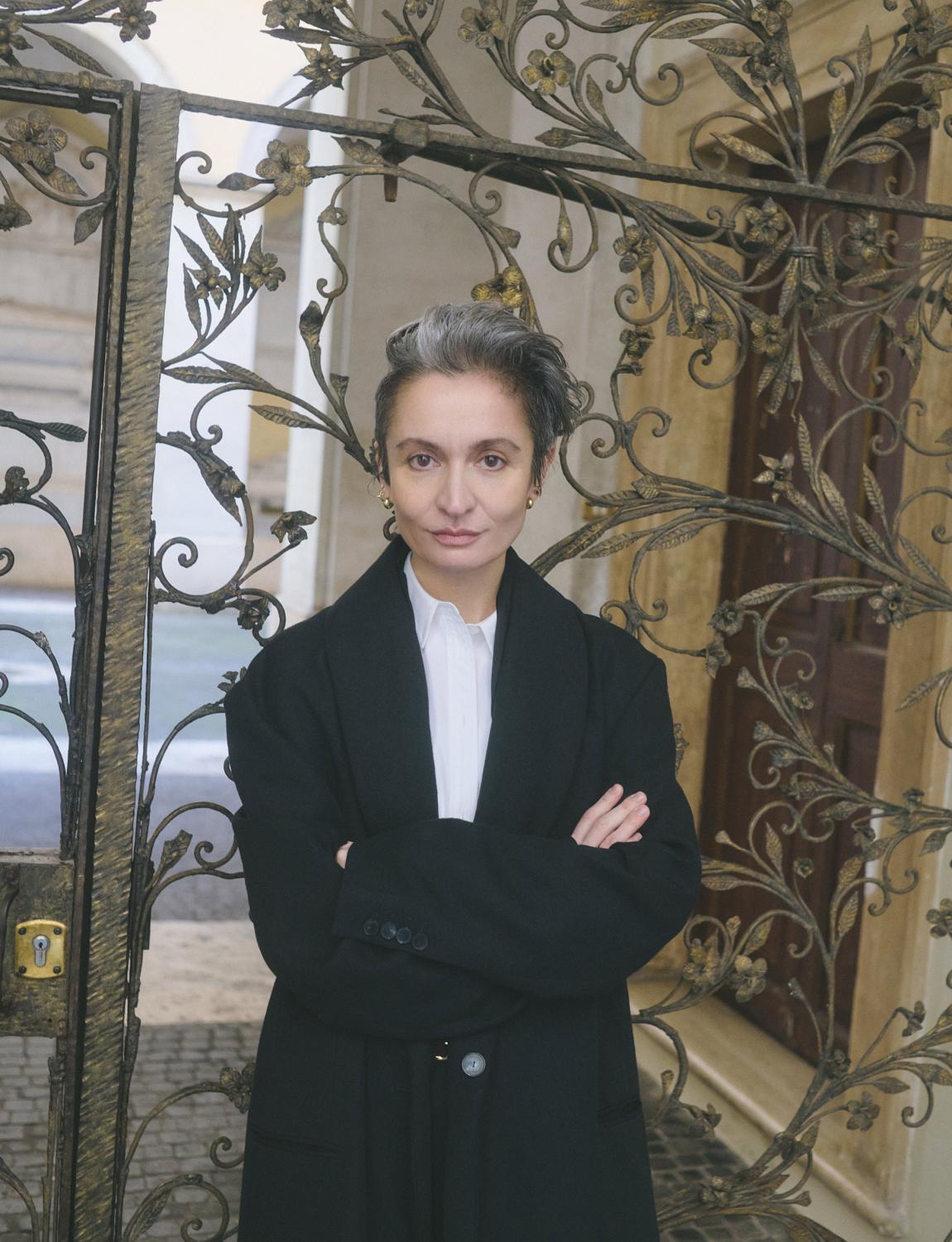
Having played her part at the most influential fashion brands of the past two decades, Veronica Leoni, 42, is bringing her precision-cut nous to Calvin Klein, as the first female creative director at the legendary American label.
Kate: I recognised you from a distance because of your distinctive hairstyle. Have you always worn it short?
Veronica: When I was a kid I did a lot of ballet, so I had it long and in a chignon. Then when I was a teenager I started to shorten it. My hair became much whiter at the front a few years ago. Now I’m waiting for my blonde period to happen.
K: Did you want to be a designer when you were a teenager?
V: Since I was four. My grandma used to make clothes for herself and for us, and I was always around that, helping her. Later, I had a circular knitting machine and made Barbie dresses in a stripy knit. I remember doing a piece for everybody in the house. No one in my family worked in fashion; they ran a coffee bar, Bar Leoni, for 50 years. But that humble part of fashion was always there.
K: You grew up here in Rome. Does it have a different take on fashion to Milan?
V: There is no Roman take on fashion. The most fashionable women in Rome are the nuns. If you go to St Peter’s on Wednesday when the pope gives his audience, you see nuns from all over the world. My phone is full of pictures of nuns. Despite a lot of fashion brands being based here since forever, Rome is not a fashion city. But Rome shaped me to be sensitive to beauty – the daily presence of beauty.
K: An ancient ruin here, a sculpture over there. It’s a pretty spectacular city to grow up in.
V: That level of beauty is quite intense but also very casual, a happy coexistence. I feel there’s a bit of that sense of casual glamour in New York too. But, of course, Rome goes deep into timeless roots, while New York projects upwards.
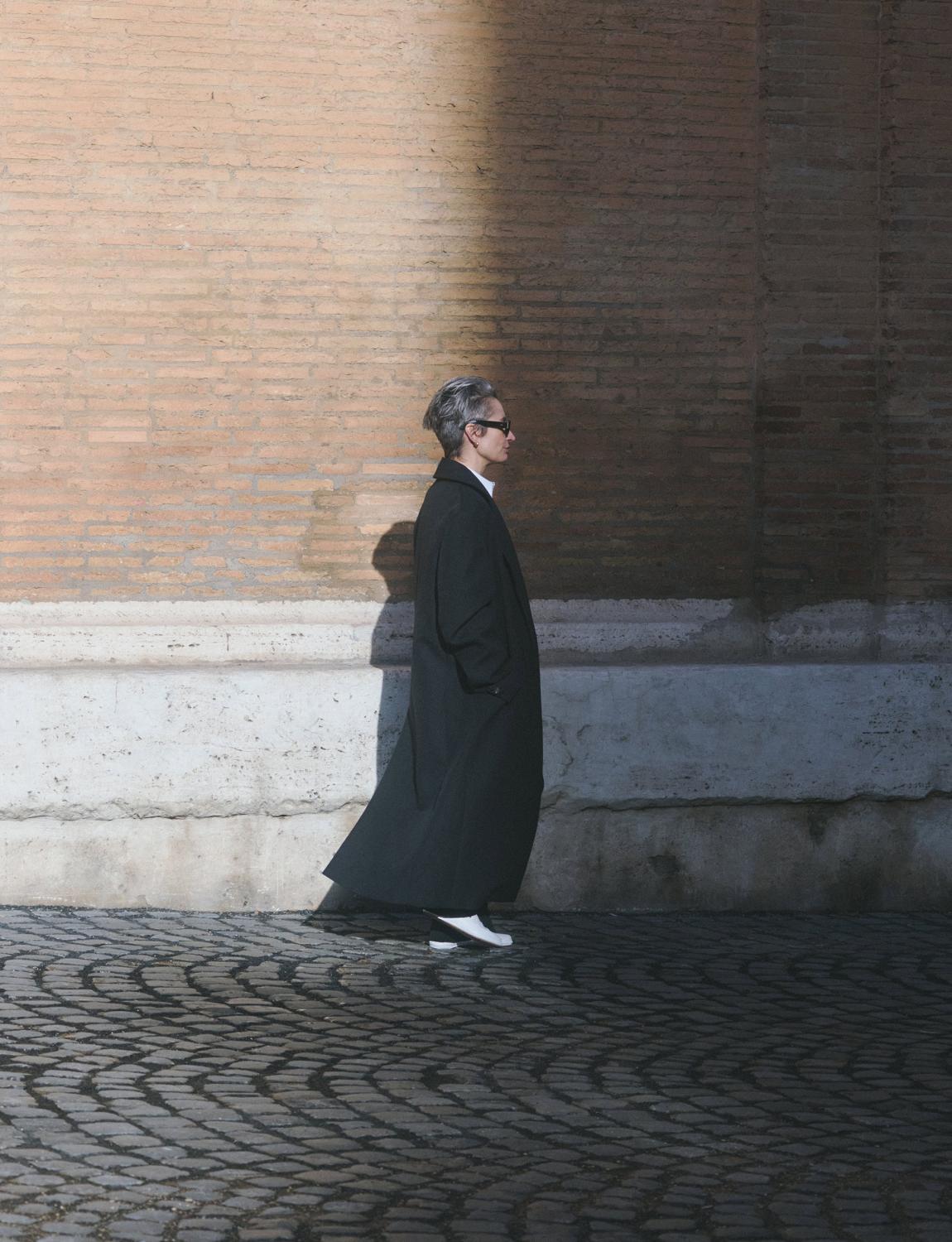
In 2024, Veronica was appointed as the creative director of Calvin Klein Collection, the first woman to hold the position. Her debut presentation at New York Fashion Week in February 2025 marked the storied American brand’s return to the runway after a seven-year hiatus.
K: Your time is now divided between here and New York. How does that work?
V: We have two Calvin Klein studios, one here in Rome and one in New York, and we try to make them as mirrored as possible visually – the same mood boards, fabric cards, colour charts. So when I fly over I find myself in a space that resembles here. It makes it very comfortable. I have to say this is my best year so far in terms of logistics.
K: How so?
V: Rome’s always been my home town, so I’ve always needed to travel to work. There have been extensive periods of my life – when I worked for Celine from 2014 and then at The Row from 2021 – where I was often in different cities for breakfast, lunch and dinner: taking a train from London to Paris to do a fitting, in the evening flying back from Paris to Rome.
K: Draining!
V: So now, two cities – and one of them being my home – makes life fabulously simple. And the New York atelier is fantastic, so I love being there. At the beginning, I was worried it might be a nightmare.
K: Why?
V: I’ve always worked on this side of the ocean and seen American brands coming over to Europe to work with us. I knew I needed the Calvin atelier in New York to inject the authority and the design signature, so I really wanted to work with them, but I had preconceptions based on those early experiences – probably from my pride at being an Italian. But the first time I entered the fitting room in New York I could see straight away: OK, I’m gonna have a good life here. I screamed with joy.
K: What made you change your mind?
V: The beautiful pieces! I really believe in hanger appeal. When I enter a room for a fitting I can see immediately whether a piece has a charm or an aura. And I loved what I saw. There was a rack of coats, tailored jackets and outerwear; they had beautiful shapes, and the fabrication was perfect. All the fear dissipated straight away.
K: What does New York do well?
V: They are very good with the flou and more sporty outerwear. I love the rigour of Italian tailoring, of course, but I love the way America does some of the tailoring – it is totally impossible to do here in Italy.
K: What’s the difference?
V: It’s a softer hand. They’re able to go much more deconstructed. They’re not afraid to lose the canvas inside. It’s also something about the shape of the shoulder. America is more courageous in that way. They break the rules.
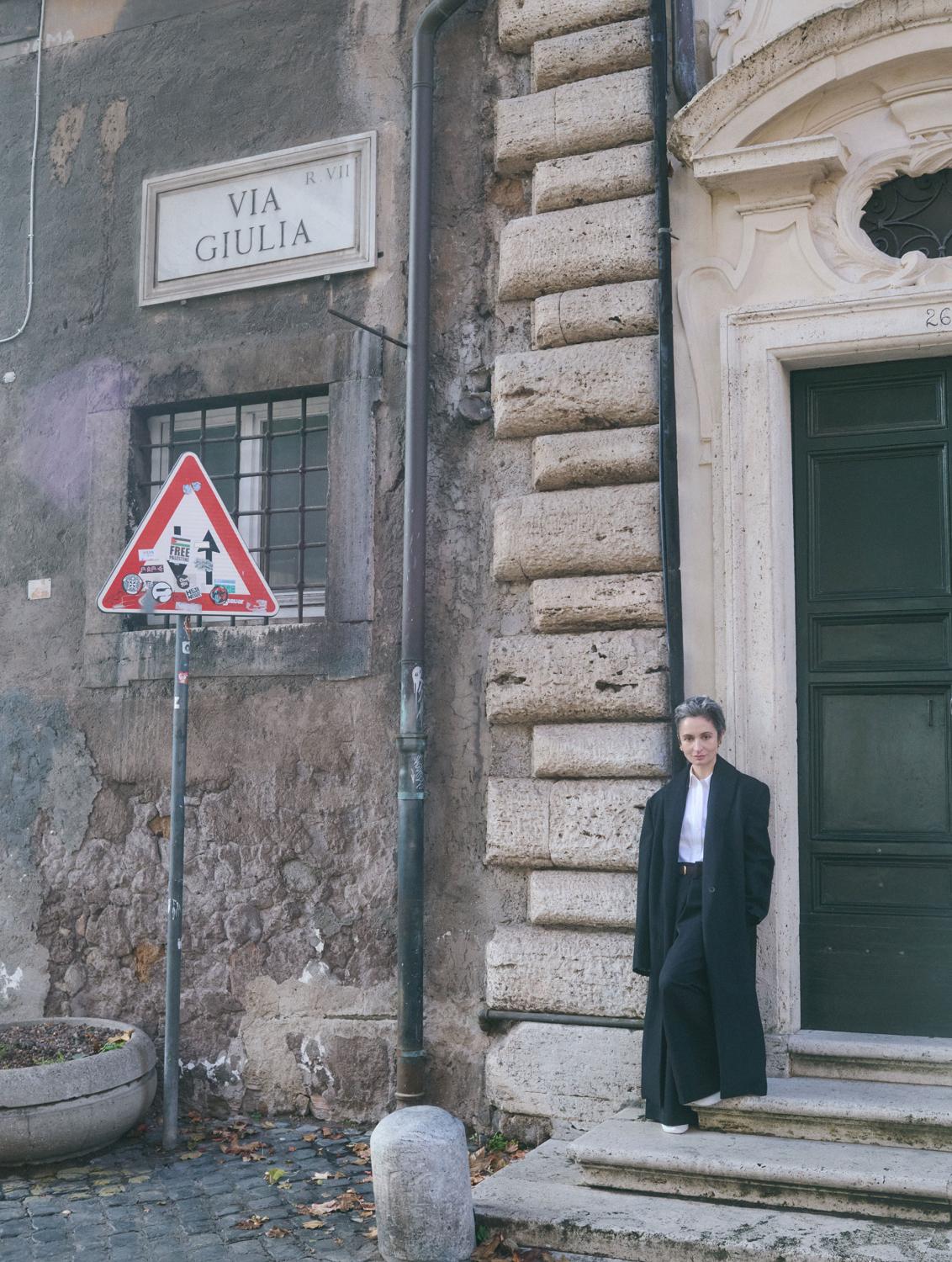
Calvin Klein started out designing coats in his native New York in 1968, at a time when the youthful counterculture was butting heads with the conservative mainstream. Just a year later his streamlined designs were on the cover of Vogue.
By the mid-1970s he was well established as the nation’s most exciting designer, but it was in the 1980s that his name went global, kicked off by a provocative advertising campaign for the denim line starring a 14-year-old Brooke Shields with the tagline: “You want to know what comes between me and my Calvins? Nothing.”
In 1982 Calvin Klein launched its distinctively branded men’s underwear, and in 1984, its first fragrance, Obsession. By then, sales were exceeding $600 million.
After a near-bankruptcy in the early 1990s, the brand was revived by the launches in 1992 of a generation-defining fragrance, CK One, and the brand’s close-fitting jersey boxer briefs, with a landmark campaign starring Mark Wahlberg and Kate Moss.
K: Was it somewhat intimidating taking on the giant history of a brand like Calvin Klein?
V: Calvin is like Santa Claus. Even if you don’t know Calvin Klein the man, you know the name. I mean, I’m sure somewhere in this hotel someone is wearing Calvin Klein underwear.
K: I’ll do a quick poll afterwards.
V: What I love is that there’s no prejudice at Calvin; there’s no snobbish attitude towards its customer. The brand’s reach goes from low to high, across generations, geography. For the past year my friends have been texting me photographs of fake Calvin Klein pieces that they see in the street. It’s funny, but it’s also a strength, this recognition. It’s pop culture.
K: How did you decide what you wanted to honour from the past?
V: I wanted to connect more to Calvin, the man himself, but also to the deepest part of the brand. The brand was very exotic to me in the 1990s – that moment of Kate Moss; I was blown away by it. But that’s not the beginning of Calvin Klein. More than 20 years of company history precede that, and it’s all in the archive, which is in Long Island, New York. There is a garment room with the collections displayed in show and runway order. As soon as you walk in, you see the process unfold, season by season. You see the shapes that he was obsessed with, how he was always drawn to a pinky tone in colour – all the browns are very pink. There was also always a buttery yellow that he called blonde gaberdine. I mean, blonde gaberdine! Going through the pieces is addictive. After a lot of time in there, I discovered an extra room with boxes of unpublished photos, which left me in tears.
K: What was in there?
V: The process behind some of the most iconic images of fashion. Kate laughing in front of Mario Sorrenti instead of being serious on the couch. The Bruce Weber picture of Iman against a white wall from 1982. A campaign for Calvin Klein Jeans that never went out. The notes between Mr Klein and the photographers – it was very emotional to read those. I also found a beautiful Isabella Rossellini dressed the way I dressed as a teenager. I used to steal my dad’s oversized shirts to wear with bleached denim. That very elegant American take on sportswear must have been my reference. My Italian-American fantasy.
K: How did that research manifest for the Spring / Summer 2026 collection?
V: The exercise with Calvin Klein Collection is to amplify that vision in a way that makes it new and relevant again. I love the take we’ve done on tailoring – the cut-out blazer with the underwear popping, and that smart take with the glasses that create a character. I also loved the first look.
K: The apron dress and headscarf?
V: Yes. The apron dresses ended
up being quite skin-exposing, but it was really about the relation a piece of cloth has with the body, trying to refine it into an essential shape and then have the body fill out what’s left.
K: You also had flashes of vivid colour. Gwyneth Paltrow wore the pink trouser suit during the publicity tour for Marty Supreme.
V: Yeah, and she had a white suit moment too. You want some good references to the key house codes that make Calvin feel like Calvin, so that as soon as she wears it it’s just, “Oh, Calvin, yeah.”
K: She can do a good Carolyn Bessette Kennedy.
V: But also, Sliding Doors was so iconic in my life. I think I cut my hair short when Sliding Doors was out. And taking the train became a radical choice every morning! There’s something about that film that feels very Calvin.
K: What else influenced you in your teens? Were you a clubber?
V: Of course. I had a lot of fun here in Rome. And I have to say my years in Milan with Jil Sander in the early 2010s were fabulous – Plastic and Toilet were my favourites. London was always a little bit more work-oriented, especially when I was working at Celine. My now wife, Sara, was living in Rome, so we were travelling every weekend either to Rome or London to try and build a life together. But it was a fun time at Celine – maybe the wildest. An English colleague who now works with me on fabric at Calvin and worked with us at Celine recently showed me a picture of a party we had at that time. Michael Rider was there, Matthieu Blazy, Dan Lee…
K: And where are they now?! What a line-up.
V: I’m so amused by Phoebe’s genius for putting us all in the same room. I want to be her in the way that she recognises talent. Working at Celine at that time gave you a fabulous perspective. You really could see how she was shaping the female wardrobe live, on the go, making stuff into a trend in the space of a minute.
K: And now you’re at the top of Calvin Klein, at a time when there are few other women in creative-director roles. What’s your take on that?
V: Well, it’s fantastic. But I don’t enjoy feeling like a panda.
K: A panda?
V: I don’t want to feel like a protected species. And it’s actually even worse than it looks, because so many of the women creative directors are also directors of their own companies: Mrs Prada, The Row, Phoebe, Khaite, Tory Burch. So in some cases the numbers of women who are actually hired as designers are even less.
K: What can be done about it?
V: First of all, I don’t support the idea that since we are women we must design for ourselves. I love to do menswear, and clearly many men can design very well for women. So there is no practical, intrinsic reason women designers can’t fill any position. The issue is that when you get interviewed for a creative-director position the person you need to convince is not another creative, it’s a businessperson. And sometimes the bromance is stronger than the connection between male leaders and female creatives.
K: What are you doing to address that at Calvin Klein?
V: I don’t feel we’re there yet; it’s early days. But I’m in charge of choosing the people, and we’ve already got a lot of girls in my team. And importantly, there’s a very strong minority of boys.
Kate FinniganKate Finnigan is a writer, editor and creative consultant, and a regular contributor to publications such as Vogue, Telegraph Magazine and the Financial Times. Fancy.read more Portraits by
Consiglio ManniConsiglio Manni was born in Puglia in February 1989. He moved to Milan and graduated with a degree in audio technology from the Accademia Teatro alla Scala and worked as a sound engineer for long enough to realise that photography was his medium. Editorial clients including Wallpaper* and Financial Times…read more
Hair: Giulio Ordonselli. Make-up: Samia Mohsein. Photography assistance: Marta Gabriele. Production and post-production: Circus Studios.
This profile was originally published in The Gentlewoman nº 33, Spring and Summer 2026.