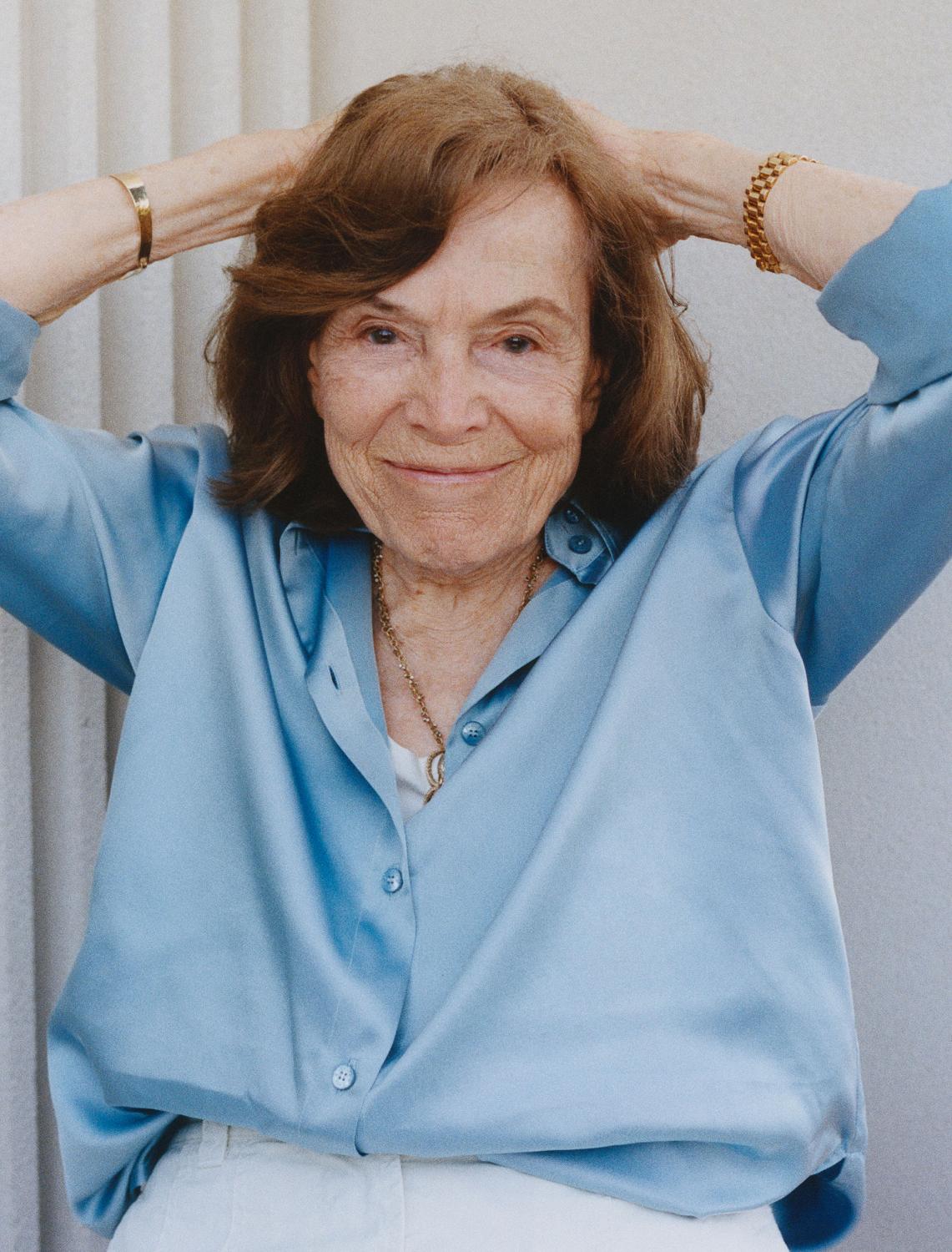
In 1979, the oceanographer Sylvia Earle descended 208 fathoms to walk untethered across the seabed. She has since lived underwater, swum with sharks and whales, angelfish and long-legged crabs, and persuaded presidents to create – and expand – marine sanctuaries. She is a rock star in ocean conservation, balancing hope against a sense of emergency, sure that now is the best time to be alive. At 91, Sylvia is still flipping backwards off boats to experience the wonders at the bottom of the deep blue sea, sea, sea.
On the hottest day of a hot summer in London, the mercury climbing towards 37C, Sylvia Earle is the picture of cool. A deep-sea kind of cool. The 90-year-old oceanographer likes to dress in shades of aqua; today, it’s a collarless suede jacket and glasses tinted a rich blue. She wears a turquoise ring and a gold octopus pendant. It’s a way of being underwater when she has to do land-based activities, such as the one she’s in London for now: speaking at Europe’s largest climate conference, where Sylvia is rock-star famous and mobbed by young conservationists in the breaks between speeches.
We meet in a Soho boardroom, in a townhouse turned over to ocean scientists for the week. Outside the glass door, delegates in lanyards wait their turn. Sylvia is a natural at the meet-and-greet – at the end of our interview, she will take my hand and press it to her cheek – having long recognised this as one half of the job of saving the seas. Today she might be preaching to the choir. Often, she faces a tougher crowd. “I go to Davos and elsewhere to listen, learn and share insights about the urgent importance of putting nature on the balance sheet,” she says. “How can a dead fish or whale or octopus or bird be more valuable than a live one?”
That urgent importance is why you are more likely to find Sylvia flipping backwards from a dive boat than looking back on an extraordinary career. Her friend Jacques Cousteau may have been the one immortalised by Wes Anderson, but a Sylvia Earle biopic would, for my money, be more fun. It would include the following: leading the first all-female underwater lab team for two weeks; riding in a ticker-tape parade through Chicago in a fur-lined limo; becoming the first woman to walk the ocean bed untethered at a depth of 1,250 feet (a record she still holds); presiding over a menagerie of children and animals, including an alligator, at her home in San Francisco; doing half of the above in fabulously stylish one-pieces.
The film director James Cameron beat one of Sylvia’s depth records (she made the deepest solo descent by a woman in a submersible) with his 2012 solo dive to the bottom of the Mariana Trench, nearly seven miles down. After he showed her around his Deepsea Challenger sub (with parts from an engineering company she runs with her elder daughter), Sylvia told him she would have been a better pilot, being smaller (she is five feet, three inches) and more experienced. Cameron has called her “the Joan of Arc of oceans” for her work to protect them. Another fan, Billie Eilish, describes her as “a warrior for the sea”; introducing Sylvia at the inaugural Nat Gala in New York last year, Eilish praised “a scientist and a storyteller… who has inspired me, along with millions of others, to care more, speak louder and protect what we love.” Sylvia’s storytelling consists of vividly written books – 13 so far – and films, including a 2014 Netflix documentary, Mission Blue.
The celebrity pals and the world records are fun, of course, and Sylvia is one of those people who rarely stops smiling. She has a resting joyful face, if you will, and resembles both Alien-era Sigourney Weaver and Amelia Earhart, whose explorer spirits she channels. But her work is deadly serious. In 70 years of exploring the oceans, Sylvia has witnessed a great vanishing of species – 90 per cent of the planet’s shark population, 50 per cent of its coral – much of it caused by overfishing and pollution. Now is still the best time to be alive, she explained in a recent TED talk, because we know so much. “We are the luckiest people ever to have arrived on earth, because we can choose the future we want. Dinosaurs could not.”
Two weeks since her last dive (with sperm whales in Mauritius) and a couple of weeks away from her next (to the Flower Garden Banks National Marine Sanctuary in the Gulf of Mexico), Sylvia balances hope against a sense of emergency. On the one hand, the whale population has increased. “When I was a child, whalers were celebrated as brave guys, going out to kill a baby whale so that the mother would come to protect it. Today most of the world abstains.” On the other hand, “We are consuming nature at a rate that puts the rest of life at risk.”
If only she could take more people 100 fathoms down, says the woman dubbed Her Deepness, to experience the wonder of a lavender jellyfish pulsing by happily in a near-frozen Arctic, or the electric fish that light up the ocean bed, we would all be converts. In the meantime, Sylvia Earle is sharing everything she has seen.
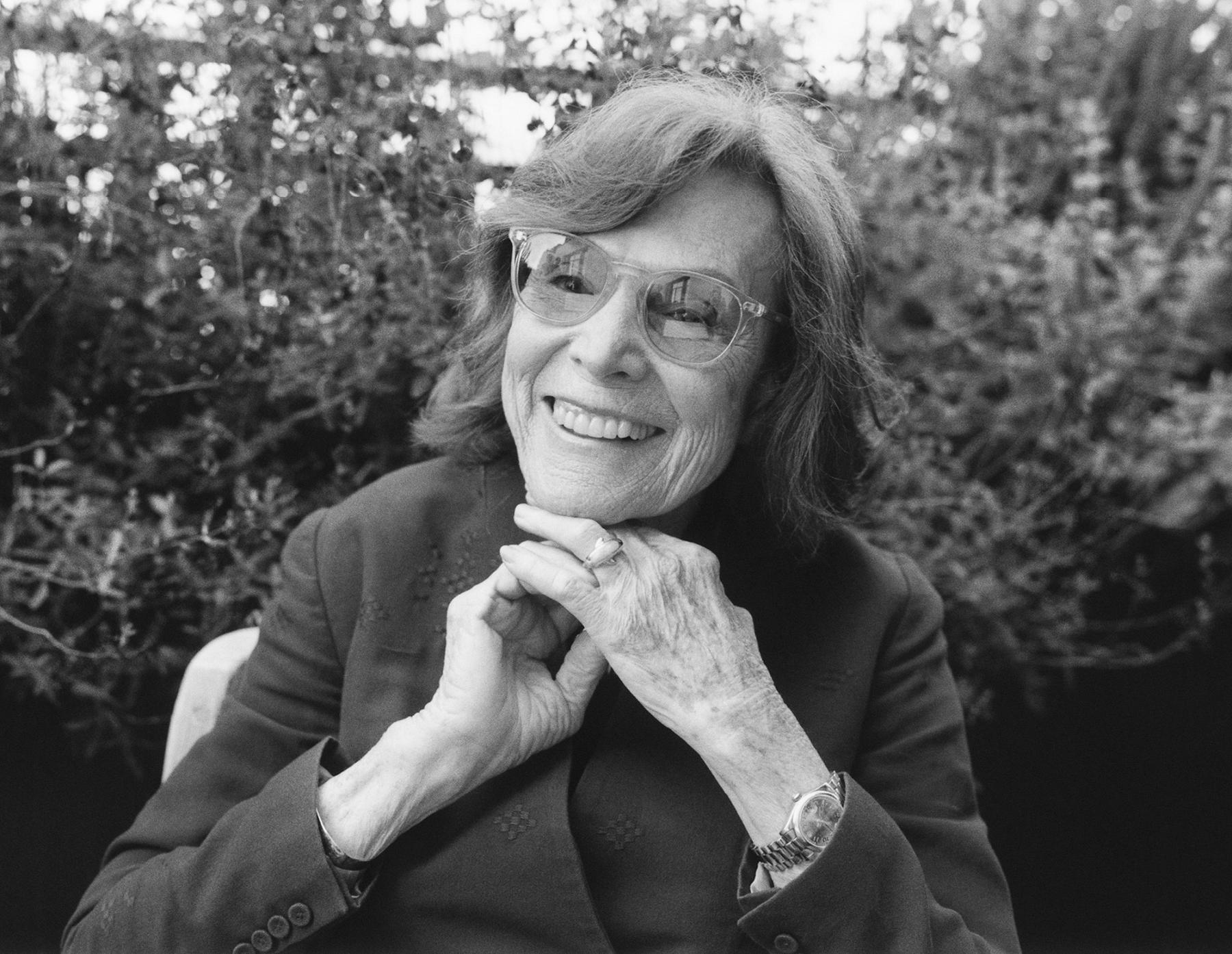
The dolphin ring, which Sylvia picked up at a craft store in Oakland, California, has an opal inset. Sylvia is wearing her own clothes and sunglasses.
THREE FIRST DIVES
Before her parents moved south to Clearwater, Florida, in 1948, Sylvia spent childhood holidays in Ocean City, New Jersey. (Nominative determinism looms large in her life.) At the age of three, she was knocked over by a wave on the New Jersey shore. “It was a little scary, because I got tumbled around,” she tells me. “My mother could have snatched me out and inspired fear. But when she saw the smile on my face she let me jump back in, and I’ve been jumping back in ever since.” Her father was an electrician, her mother a homemaker. Their first four children, all boys, had died young. Sylvia was their sixth, born between an older and a younger brother, and her parents supported her ambition to be a scientist from the start.
Florida in the 1940s and 1950s was a water baby’s paradise, long before the Gulf of Mexico was transformed by mass tourism and oil spills. North of Clearwater, the Weeki Wachee river had water so crystalline it looked empty, and from 1947 it hosted a weekly “mermaid show”, with divers walking the tightrope and eating dinner while breathing through hoses.
Sylvia breathed her first compressed air diving in the Weeki Wachee when she was 17. “I wore a copper helmet that belonged to our next-door neighbour, a sponge diver. I was with his son and my older brother – the kid sister who tagged along,” she says. “I thought it would be a chance to see the fish, but as soon as I was in they came swarming over. They were curious. It was a two-way street.”
She went on to study marine biology in Florida and wrote her PhD on algae at Duke University in North Carolina. (Sylvia’s 20,000 specimens are now stored at the Smithsonian Institution’s National Museum of Natural History in Washington, DC, pressed flat like flowers and hand-annotated.)
In the summer of 1953, one of her professors got hold of two of the earliest scuba tanks, co-invented by Jacques Cousteau. “It had a big mouthpiece that was intended for [male] navy divers, and I was given two words of instruction: breathe naturally. And that was it – over the side.” The main thing was to take your time ascending, to avoid the bends. “Which Cousteau did not when he began. He almost killed himself several times.” Sylvia brushes off questions about near misses of her own – highways are more dangerous, she says – though a 1989 New Yorker profile reported she had once had to karate-kick an over-curious shark.
“I was given two words of instruction: breathe naturally. And that was it – over the side.”
HANKY-PANKY ON THE REEF
The 1960s were a golden age of American exploration, of both space and the deep sea. Nasa poured money in both directions. But it didn’t bargain on women being interested, and willing to leave their children. It would be 1983 before they sent an American woman into space, 22 years after the first man.
Sylvia joined her first overseas research trip, to the Indian Ocean, in 1964. Aged 28, she left two small children with her then husband, Jack Taylor. “Someone who was much better qualified had to step away at the last minute. I had a call from the head of the expedition, who said, ‘You’re going to be the only woman. Is that all right with you and your husband?” In Kenya, the scientists were interviewed by the Mombasa Daily Times. “The headline was ‘Sylvia Sails Away with 70 Men, but She Expects No Problems’. It made me wary of the press.” But there were, in fact, no problems. “It actually was very fine. I have two brothers, and I’d learned that you don’t expect any favours.”
In 1968, four months pregnant with her third child, Sylvia became the first woman to “lock out” of a submersible at depth (entering and exiting a pressurised hatch in much the same way an astronaut leaves a spacecraft). The same year, she applied for a place at the underwater lab Tektite in the US Virgin Islands along with a team of male scientists: she would study the seaweed, they would do the fish. The panel loved their proposal, less so the idea of a mixed team, and it turned her down.
“The worry, and I’m not kidding, was hanky-panky on the reef,” Sylvia says, smiling. “It was as simple as that. Men and women ride buses together, they use the same bathroom on aeroplanes, they go camping together. We could figure this out. But they wanted a separate all-female team.”
So Sylvia led four other women to Tektite II in 1970 – after a photocall in bikinis (Sylvia wore a two-tone one-piece with cutaway sides) and headlines that included “5 Gals Face Plunge with One Hairdryer”. Today she shrugs off the sexism and “aquababes” epithets: at least people were interested. “There was a Brazilian PhD who was every bit as qualified as me, but anyway I got to be the boss. There was mutual respect.” The women spent two weeks at a depth of 13 metres, moving between lab, living space, and a wet room with a hatch to swim out of. But the real lab was outside, Sylvia says. They swam for up to 12 hours a day, using newly invented rebreathers, tanks which recycle a diver’s air supply. She got to know a family of angelfish, recognising them by their faces and habits.
Sylvia has lived underwater nine times since, for a total of 88 days, and says there’s little difference between mixed and female teams. As on the International Space Station, everyone is there to work. “On Tektite II, we were isolated from those at the surface, to simulate what Nasa was interested in,” she says. The project was sponsored by the space agency, the US Navy and the Smithsonian. “What happens when you’re in space? You can’t call out for a spare part. Or say ‘I’d really like some ice cream.’”
She and the other aquanauts were celebrities when they resurfaced, invited to the White House by President Nixon and serenaded by Mahalia Jackson in Chicago. It was just a year after Neil Armstrong and Buzz Aldrin had walked on the moon – a destination that interests Sylvia far less. “We seem more entranced with the moon and Mars and beyond than getting to know this planet,” she says of today’s American space programme. “Aquanauts are drawn to places where life abounds. In space, there’s not so much.”
ONE GIANT DIVE FOR WOMANKIND
One reason nobody has beaten Sylvia’s 1979 record for the deepest untethered dive by a woman is that it is dangerous to try. Complicated is the word she prefers. She wore a pressurised Jim suit, developed for use by divers repairing oil rigs and pipelines rather than research scientists. (On the plus side, you could go deeper[LM1] ; on the minus, it was heavy and hard to manoeuvre.) “I didn’t think it was risky,” she says. “It simply wasn’t practical.” On two practice dives, she lost communication with the sub that had taken her down.
In footage of that dive, off the coast of Oahu, Hawaii, Sylvia climbs into a clumsy-looking humanoid tank with four “eyes” – windows set into its spherical head. Then she is strapped to the front of a small yellow sub and piloted to the ocean floor, the Jim suit’s arms locked at right angles. At the bottom, Sylvia’s hand can be seen wiping condensation from inside an eye, and then she is off, for two and a half hours. Balancing in the suit’s articulated legs, she moves like a moonwalker, an American flag rippling in the current behind her.
At first it looked dark, she recalls in Mission Blue, the Netflix film. “Then there were thousands of sparkles and flashes – fish with little lights down their side.” She saw long-legged red crabs. Tall sea pens, a form of soft coral, swayed from the sand. “Nobody had done anything like it, before or since.”
She had previously had problems with the suit’s rotating hands and complained about them to the British chief engineer, not realising he had designed them. Now they worked like a dream. Seven years later, Sylvia married him. “They had been like pliers; you could only pinch with them. I provoked him to come up with something better. And they were so sensitive to your control that you could sign a cheque with them. Our conversation continued.”
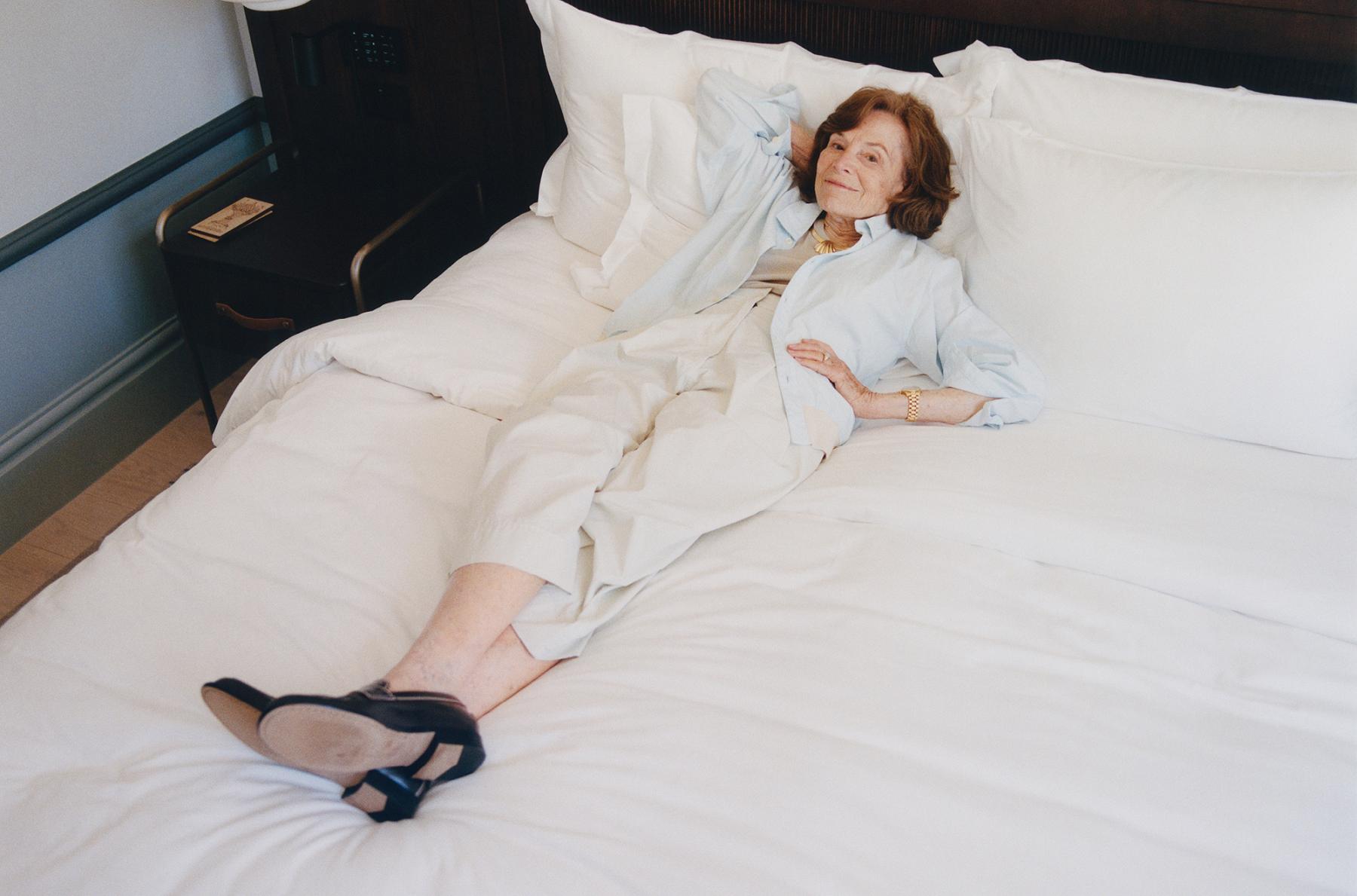
Sylvia luxuriates in a light blue cotton shirt by Stefan Cooke, a hazelwood cotton vest by Sunspel, chalk cotton culottes by MHL by Margaret Howell, as before, and black leather loafers by Tod’s.
THREE COLLABORATORS
The engineer, Graham Hawkes, was Sylvia’s third husband. He later had a cameo in the 1981 James Bond film For Your Eyes Only, playing a Jim-suited diver in a self-designed submersible who attacks Roger Moore and Carole Bouquet. Sylvia had teenagers by the time they married – Liz and John from her first marriage to Jack Taylor, Gale from her second to Giles Mead – and she later said she and Hawkes raised submersibles instead of children. Until their (amicable) divorce in 1992, the family lived in San Francisco in a household that included two dogs, six cats, parrots, snakes and an alligator called Charlie. “Charlie has now gone the way of all alligators,” Sylvia says. “But his spirit lives on.”
Her husbands have all been scientists, a fact she puts down to her passion for the sea and her need to see more of it. “They can do what I cannot. That’s how humans have conquered the world: we collaborate.” In Mission Blue, she puts it more simply: “I wasn’t interested in anyone who wasn’t interested in what I was. Football schmootball.”
Jack Taylor was a zoologist; she married him soon after graduating in a mortarboard and blue flippers. Giles Mead was an ichthyologist who later ran the Natural History Museum in Los Angeles. For several happy years they lived in a big house off Wilshire Boulevard with their six children (Mead had three from his first marriage), but Sylvia has said it became tricky to be “Mrs Museum” and pursue her own ambitions. In 1975 they were invited on a research trip to the Comoro Islands, but Mead never arrived, and they divorced soon afterwards.
Sylvia’s children have all inherited what she calls “the urge to submerge”. Her first dive with all three – and “Sandy the friendly dolphin” – was in the Bahamas in 1978, when the youngest was 10, and they have never stopped. “My great-grandson is three, so he’s got a way to go,” she says. “One of my grandsons specialises in the biogeochemistry of the ocean. My older daughter, Liz, runs the [Deep Ocean Exploration and Research] submersible business with her husband, Ian Griffith.”
Sylvia’s own fantasy sub is deeply democratic. She came up with a clear acrylic design in 1986 which is not yet seaworthy, though Liz is getting there. Sylvia’s dream is of something silent, dark and see-through, where anyone can take the controls and the fish barely know you’re there. “They are launching a new class of three-person subs in French Polynesia. I look forward to diving in the new Honu sub soon!”
PRESIDENTS, GOOD AND BAD
There’s a wonderful photograph of Sylvia with Barack Obama, taken in 2016 on Midway Atoll, a chain of islands bang in the middle of the Pacific. They’re giving their megawatt grins against a backdrop of white sand and turquoise water as Sylvia shows the president a photo of a newly discovered orange coral-reef fish named after him, the Tosanoides obama. He has just quadrupled the area of a surrounding marine sanctuary, and it’s a picture of hope.
The origins of that meeting lie with George HW Bush and, before him, Barbara Bush, Sylvia says. “She had gone to Midway and seen all the trash that was there and felt this compassion.” The First Lady arranged a screening of a documentary about the islands, followed by dinner.
“I took the last place at the table, next to President Bush. When I saw him sitting there, I thought, No, somebody else needs to be at that table. But my feet kept walking. In the hour and a half that followed, it was just a conversation about why marine sanctuaries were so important, and Bush, to his credit, listened. When he left the table, he turned back and said to the head of the environmental council, ‘Jim, make it happen. Full protection, no fishing.’ He had no idea that killing fish for fun was not only permitted, it was encouraged. He said, ‘Why call them sanctuaries?’”
In recent years, President Trump has rolled back those protections. “It means we have a long way to go to get to 30 per cent.” Sylvia wants that proportion of the oceans protected by 2030, against an existing 3 per cent. Encouragingly, “the High Seas Treaty was recently ratified by enough countries to make it legally binding,” she tells me. The agreement protects marine life in the oceans and the deep seabed, creates marine protected areas and regulates high-seas activity. She has spoken persuasively at Davos, the UN, the Senate. Could she get a meeting with Trump? She doesn’t see the point. “Trump is an aberration. He’s the exception. We have other politicians who are strongly in favour of protections.”
In 1990, President Bush appointed Sylvia chief scientist for the National Oceanic and Atmospheric Administration. The official role took her to the Persian Gulf nine times to advise on the impact of war and oil spills. She went to one meeting of one of the US fisheries council and spoke about the near extinction of tuna; she was not invited back (the industry dubbed her “the Sturgeon General”). After two years, she resigned.
She can do more as a private citizen, Sylvia argues. And being slight and older can be an advantage: nobody expects strong opinions. She has them. For instance, what does Sylvia make of billionaire Peter Thiel’s recent investment in floating data centres planned for the Pacific? “A recipe for disaster. Period. There is a common illusion that ocean space is free real estate where guidelines governing human behaviour do not apply. Carving up the ocean for financial gain for a few, that incurs costs for everyone, is morally wrong.”
FINDING THE HOPE
If there has been research into the longevity of our great conservationists, Sylvia doesn’t know of it. “But it’s a purposeful life,” she says. “You wake up ready to go. It’s been a privilege to be a witness – like Jane Goodall, like David Attenborough – to a time when nature was more intact.” Like them, she has the gift of giving terrible news with a smile on her face, making you see that her joy in nature is part of the message: Why destroy the planet when it is so valuable? “I can’t believe how much we put into killing things – forests, fish, one another. The weapons of war are a high priority, and taking care of our future is not.”
Sylvia gets all the protein she needs from vegetable sources – as do most fish, she points out. “If you have to eat animals, choose those that eat plants. Go to a short food chain. As it is, we don’t eat 15-year-old cows or 20-year-old chickens, but we happily eat 15-year-old fish and some that are over 100. Orange roughy, for example, or sharks. Come on. Be wise.”
Since 2009, Sylvia has campaigned for Hope Spots, environmentally protected underwater parks. There are now 170, off 116 countries, and she can point to habitats that have recovered, such as Shinnecock Bay on Long Island, New York. “It was in great trouble until some clever champions decided to put millions of clams back. Now the water is clear – thank you, clams. The seagrasses came back, the crabs, the lobster. Hope leading to action works.”
“Sylvia is a complete force of nature. She changes how we look at the world and how we feel about it,” Gail Gallie, the founder of the Nat, tells me by email from New York. The Nat focuses on accelerating investment in nature; Sylvia is a key partner in its annual gala (theme this year: ocean). “She is a master storyteller, and constant proof that positive change is within our grasp,” Gail adds.
IT'S ALWAYS ABOUT THE NEXT DIVE
The most recent novel by the Pulitzer Prize winner Richard Powers, Playground, features a character inspired by Sylvia: a marine biologist called Evie Beaulieu who wants the sea to be her final resting place. This isn’t something Sylvia thinks about, and she has yet to read the book. “I have a copy that I look forward to reading, but a burial at sea? Maybe if I fall overboard.”
Instead, she’s focused on her next dive. Her fantasy is to come back “50 years from now and dive in places that I know today, to see if our safeguards have worked.” In the meantime, you’ll find her swimming with sperm whales, a slight figure finning in their shadows, always with that amazed smile on her face and a sense of her significance in the grand scheme of things. “These animals have the biggest brains on the planet. We think we’re so smart. They’re smart enough not to destroy the world they’ve been living in for 30 million years. It’s time to pull up our socks. Look in the mirror, find your superpower. Everybody has something. Use it.”
Melissa DenesWhy is breastfeeding so hard? How do the artist Ana Mendieta’s closest friends remember her? These are just two of the subjects that Melissa has recently grappled with in her capacity as one of the most sought-after features writers in Fleet Street. With her editor’s hat on, she has worked at The…read more Portraits by
Alice NealeLondon-based photographer Alice Neale graduated from Central Saint Martins in 2015 and has worked with some of the most celebrated magazines and fashion brands in the UK and Europe such as AnOther, Re-Edition, Noon,The New York Times, Prada, Miu Miu, Rimowa and Wales Bonner. Alice is represented by Artistry.read more
Grooming: Takuya Uchiyama, using Maria Nila. Lighting assistance: Sami Weller. Production: Artistry.
This profile was originally published in The Gentlewoman nº 34, Autumn and Winter 2026.