Solange
the brilliant, ever-evolving cultural icon
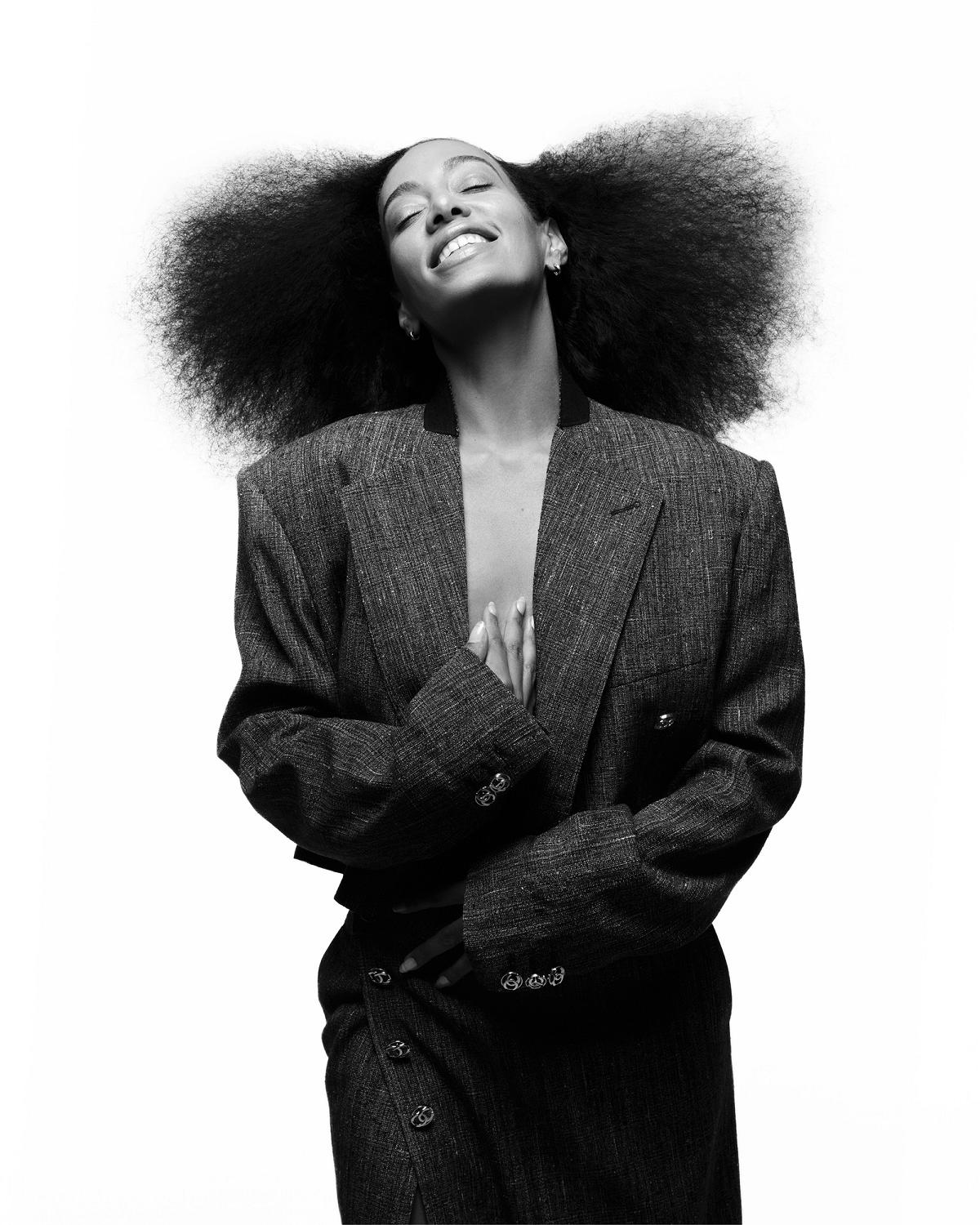
Portraits by Inez & Vinoodh
Styling by Xenia May Settel
Issue nº 33, Spring and Summer 2026
A megawatt pop star with a lending library and her own college course – Solange takes us on a tour of the earthly manifestations of her radical imagination.
One Wednesday afternoon in Manhattan, I walk through a door next to a nail salon, climb to the top of a steep staircase and enter a room in which everything, even the furniture, seems laden with meaning. At the room’s centre is a sofa shaped like an S. Either side of it, on plinths, are a pair of spherical glass objects. A series of black-and-white photographs are fixed to a wall in the shape of a crucifix. Certain areas are dedicated to African masks. On an entirely transparent desk, a book of music notation lies neatly open. There’s a wooden sound system for playing vinyl.
Solange Knowles – the singer-songwriter, Grammy winner, furniture designer, contemporary artist, choreographer and cultural icon, not to mention founder of the organisation Saint Heron, whose premises I have just entered – asks if I prefer still or sparkling.
There are lots of books. I look over the shelf by the stairs and spot a familiar title: Madam Zenobia’s Space Age Lucky Eleven Dream and Astrology Book. Solange had mentioned it when we spoke on the phone last week. “It really taught me radical imagination,” she said. “This woman basically created her own astrology system. I love that it was written in the 1980s by a Black woman who lived in Philadelphia and that she gave herself permission to say, ‘I don’t need Greek mythology to tell me what my patterns are, what my associations are. This is my own system, and I will document it as such.’”
This struck me as a fairly good way of describing Saint Heron: that it is Solange’s own system, and she documents it as such. Having begun life in 2013 as a compilation album for “genre-defying R&B visionaries”, its work since then has encompassed art, publishing, design, performance and, most recently, a free lending library that ships rare books by Black authors to readers across the United States. The list of 62 titles includes novels, poetry collections, exhibition catalogues and a research journal Saint Heron published last year about the life and work of the modernist architect Amaza Lee Meredith (who also worked as an artist and teacher and lived with her female partner at a time of Jim Crow segregation laws and heterosexual norms).
In our call, Solange told me how Meredith’s was a name she encountered while researching Black architects so as to “feel less alone”; she had come to realise that some of her own projects were, in a sense, buildings. One was “Metatron’s Cube”, a giant minimalist white sculpture with a set of stairs inside (it could almost be an MC Escher drawing), created for a dance performance at LA’s Hammer Museum in 2018. Another was “Boundless Body”, a huge rodeo arena in the desert in Marfa, Texas, which appeared in the film that accompanied her most recent album, 2019’s universally acclaimed When I Get Home – a love letter to her home town of Houston, Texas. Solange came to see Meredith as “the embodiment of everything that I have tried to achieve within all of the mediums that I practise, and of how they connect and are in constant conversation with one another.”
Solange – who speaks in a mellifluous southern US accent and is wearing a chocolate-brown ribbed quarter-neck jumper and a shiny pair of trousers, both by Lemaire – brings our water in a pair of heavy glass goblets. I recognise them as belonging to her range of hand-blown glassware, made in collaboration with the glass artist Jason McDonald, who told me in an email, “So many artists overcommit to the thing they are known for, but Solange’s interests are incredibly varied. She thinks beyond material specificity and reaches for the best tool to communicate.”
The spheres on the plinths, it turns out, are a sequel of sorts: whisky decanters, designed to resemble planetary bodies. Solange hopes to release them in the next few months. She leads me to a pyramidical resin sculpture attached to the wall. “This is my piece ‘Orion’s Rise’.” The 2018 sculpture was included in the Metropolitan Museum’s Flight into Egypt: Black Artists and Ancient Egypt, 1876–Now exhibition in 2024–25. “It’s similar to the decanters; if you stand here, on the other side of it, you completely lose the transparency.” I move accordingly. “But then when you shift your perspective you’re able to see through the image.”
As in a museum, everything in the Saint Heron workspace can be understood in different ways. Take the sofa, which Solange began designing in 2020. There’s the functional story: she explains how it’s not an uninterrupted S but a customisable series of modular components that can be arranged in different ways, though she’s still perfecting the means of connection following a failed experiment with strong magnets. There’s the retail story: this is only a prototype, the third so far, and they’re not available to buy yet.
“I hoard almost obsessively, and then the real power is in the minimisation of those things, the taking away and the subtraction.”
But then she tells the story about why she wanted to make it, and suddenly what’s striking is not so much the question of who would design a sofa the year after making a Billboard top 10 album (vaguely comparable projects, such as Tyler, the Creator’s line of bedding for Parachute, aren’t common but do exist) but how much the sofa and record have in common. How they are both, on some level, the product of Solange’s childhood.
“I travelled so much as a kid and lived a very nomadic life,” she says. “I never went to high school. Airports, hotels, venues, train stations – those were the lens that I saw the world through, and I would notice if one made me feel less alone or a little bit more held. I paid attention to the way that space made me feel safe, or if I went to a venue and I noticed a sofa made me feel a little warmer or a little bit more connected.”
She is referring to the teenage years she spent as a backing dancer with Destiny’s Child – notably featuring her sister, Beyoncé, and managed by her father, Mathew Knowles – at the height of the group’s global ascent. When a torn meniscus ended her hopes of studying contemporary dance formally (“I was on a trajectory to go to Juilliard”), she began writing instead. The first songs, or “emo jams”, were a way of dealing with the end of that dream, one she had held since witnessing – at about age 12 – a performance by Houston Ballet’s Lauren Anderson, one of the first Black ballerinas to become a principal at a major dance company. Kelly Rowland heard the material and asked Solange to write for her solo record Simply Deep. “I don’t know what my life would have been like if she hadn’t.”
The turn towards songwriting was formalised in 2002 when, at 16, Solange released her own debut album. In many ways, Solo Star came across as an exemplary product of the early-2000s R&B machine. There were production credits for Timbaland and the Neptunes and cameos from Lil’ Romeo, Da Brat and her already staggeringly famous sister. Although it sounds very different to her later records, it arguably prefigures them in feeling at once like the work of a singular talent and the result of bountiful collaboration.
We walk over to the photographs. They were arranged as a cruciform, Solange says, by her 21-year-old son, Julez Smith. “I told him the order to put them in and he installed it. I love that I get to feel his presence in the space every day.” Most were taken by Solange herself. “This is a crater in New Mexico where a meteor hit a mountain, and I love reminders of how small we are. That’s a waterfall that I found in the Bronx. This is my dad in Egypt on the trip that I was conceived in. This is the Pyramid of the Sun in Mexico. That’s my favourite bayou in New Iberia, Louisiana, near where my mom is from.”
When Solange’s maternal family left Louisiana, it was thanks to a chain of events triggered by a catastrophic explosion at a mine. Her grandfather, a miner, had been working there when the incident occurred. Preferring not to spend money looking for survivors, the mine’s owners simply stated there were none. “His brothers just knew in their bodies and spirits that their brother was still alive, so they assembled their own crew to go and rescue him, and they did. They saved him,” Solange recounts. “They threatened to take legal action, and very racist, racially motivated threats started to happen.” The family fled to Texas. Solange and Beyoncé grew up in Third Ward in Houston, historically a centre of the city’s African American community. Their father was working to build a music company, and their mother, Tina Knowles (whose bestselling memoir, Matriarch, was published last year), owned a renowned hair salon.
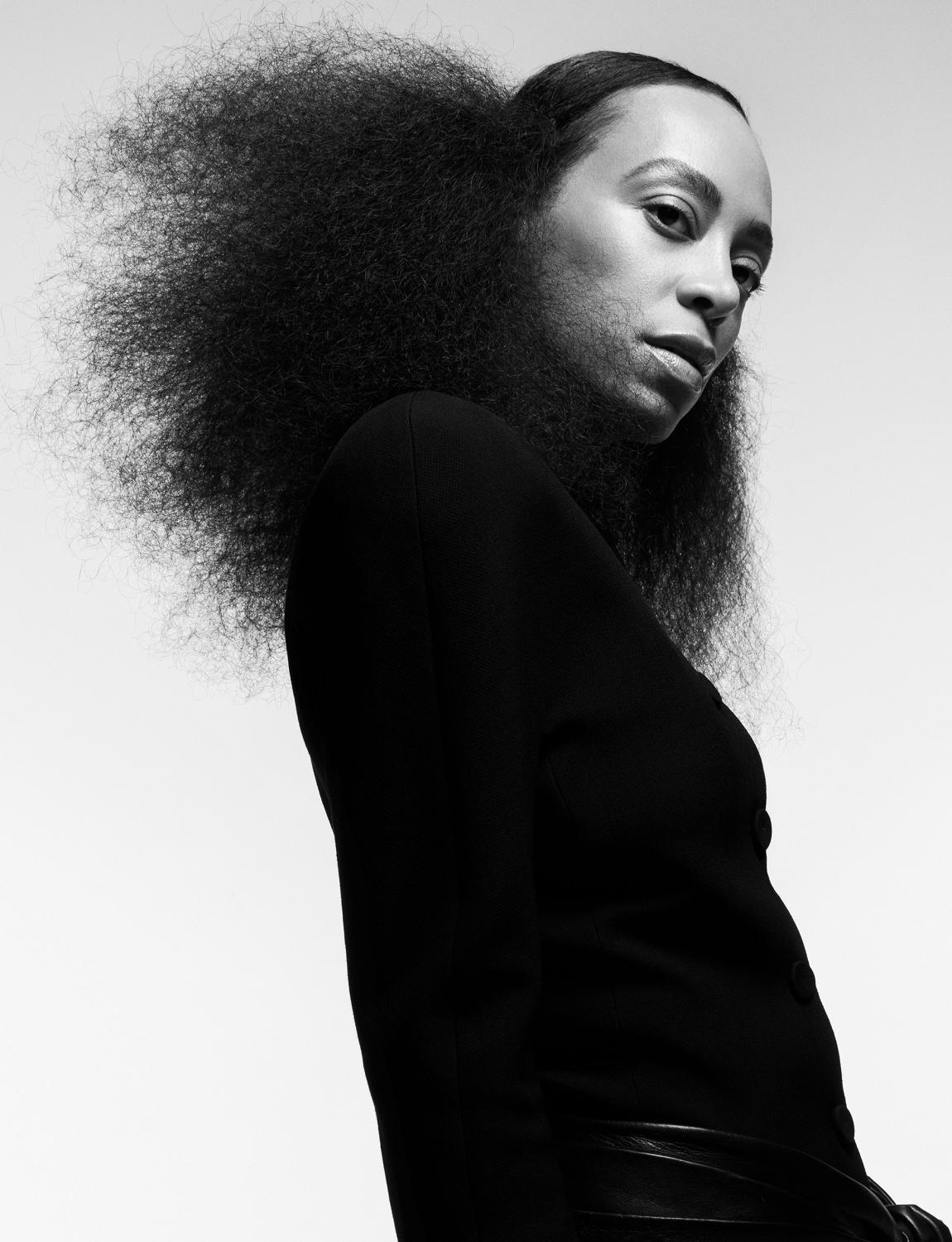
Photographed in Chelsea, Manhattan – six blocks from the Saint Heron HQ – Solange is wearing a black wool jacket by CHLOÉ with a black leather belt, also by CHLOÉ.
Solange’s next album, 2008’s Sol-Angel and the Hadley St. Dreams, represented a break from the conventions of contemporary R&B. Despite channelling the pop soul of the 1960s and 1970s, it really wasn’t as retro as some critics insisted. Rather, it took the conventions of Motown-style girl bands and repurposed them, blending them with newer genres, updating them. “I remember deciding that I wanted to have a German electronic techno outro,” she says. “And I remember the conversations: ‘Why does she ruin the song going to that crazy techno music?’ and ‘She doesn’t dress like she listens to techno.’”
A lot had happened between albums one and two. Solange had married her boyfriend, Daniel Smith, when she was 17, and given birth to Julez the following year. Now she was newly divorced, barely out of her teens and raising a young son. She split her time between Los Angeles and Houston. (Solange would go on to marry the music video director Alan Ferguson in 2014. They would separate in 2019.)
But anyway, why the crucifix? “I have been thinking a lot about slow death,” she says, with a mysterious smile. In what sense? “I’ve been really reflecting about what it means to have rebirth. I’m in a space of rebirth. It’s very, very strong. I think it’s aligned with an important shift in age – I soon turn 40 – and what that means to me. But I think this new version of myself that I’m trying to usher in is rooted in knowing that I have to move more slowly in order to be the best version of myself, the most kind version of myself, to both myself and to others.”
On a wooden table Solange has arranged some piles of books. I had asked her about recent favourites during our earlier call. Titles include The Modern Spirit – Glass from Finland; Comrade Sisters: Women of the Black Panther Party; Clay Culture: Plasters, Paints and Preservation; Martha Graham: When Dance Became Modern; and the Handbook of Black Librarianship.
Solange has always had the aura of someone whose work is built on real research – someone who does the reading. She has lately been announced as the first scholar-in-residence at USC Thornton School of Music in Los Angeles. In 2027 she will start teaching the course Records of Discovery: Saint Heron’s Methodologies for Music and Cultural Curatorial Practices. How’s the prep going? “I already have the 15 classes,” she says. “I have all of the lectures. They’re titled; the framework is all there.”
Does she feel that missing out on high school has fed into her ravenous desire for knowledge? “Definitely,” she says. “When I was younger my parents would always say, ‘You’re either going to be a teacher or a lawyer,’ because I was always a seeker, a studier. I always liked facts, I always liked evidence.” She gestures at the work around us. “In a way, this is all evidence that I was here and of how I saw the world. I think a lot about mortality. There are pieces of glass that exist that are thousands of years old. So in some way I did become a teacher and a lawyer, in the sense that I’m constantly fighting for my truth, and the truth of my ancestors.” She reads in the bath, she says, and on the road. Flying triggers her health issues (she was diagnosed in 2018 with three interrelated conditions, including Sjögren’s syndrome, an immune system disorder), so she often travels long distances by car, reading during the stops along the way.
“I think about Sade, Kate Bush, D’Angelo, who I feel all know or knew that a life has to be lived in order to have something to write about.”
After Sol-Angel came 2012’s seven-track EP, True, made in close collaboration with the British singer-songwriter and producer Devonté Hynes. Here, the Motown and pop-soul references were cleared away in favour of a sonic palette drawn from, but not beholden to, 1980s pop and 1990s neo soul. It has aged well. You could go back in time and withhold it till today and it would still be groundbreaking.
A limited-edition cover of True featured a collage portrait of Solange reclining on a floral day bed, by the artist Mickalene Thomas. This, along with the music video for “Losing You”, directed by Melina Matsoukas and shot in the township of Langa, Cape Town, signalled Solange’s growing interest in the curatorial power she could wield. Matsoukas calls Solange “the most inspiring artist I’ve ever worked with” and “one of the most important artists of our time.” Interviewed over email, she says Solange “has an extremely unconventional way of working and is always carving her own path, even in process. It’s never comfortable, it’s real work trying to create something fresh and classic, but it is always the most satisfying.”
Solange shows me into a smaller room. There are more books and what may be hundreds of glasses and decanters displayed on shelves. “These are all the variants of the decanter before I got to the final ones, and these are all the different proportion studies I did of the hand-blown glass,” she says. The subtle differences between them are impossible to gauge at a glance. Does she see similarities between making glassware and writing a song? “Yeah, but I had to think about it for a while to identify the pattern,” she says. “In all these things, I macro, macro, macro, macro. I gather, gather, gather, gather. I research, research, research. I hoard almost obsessively, and then the real power is in the minimisation of those things, the taking away and the subtraction.” She holds up a large-format art book. “This is the very first book I published,” she says. It accompanied her lavish yet poised third album, the one that propelled her into the cultural stratosphere, 2016’s A Seat at the Table. Released jointly by Columbia and Solange’s own Saint Records (founded alongside Saint Heron three years earlier), the album’s 21 tracks, including spoken interludes from her parents and the legendary rapper Master P, present a chronicle of Black America as seen through the prism of Solange’s own inner reckonings. It topped the US album chart, and the song “Cranes in the Sky”, a meditation on suppressed sadness written during the breakup of her first marriage, won the Grammy for Best R&B Performance.
“There are times when you’re on that fifth hour of listening for a 10-second loop and you think you’re insane. Why are you listening through six hours to find 10 seconds?”
Solange talks about that album as something like the end of a journey. “It was my first offering as both producer and songwriter in totality, and because of that, it created a landscape that was entirely my own, although I had people who shared that space with me,” she says. “I had a very clear vision of the sound that I wanted to achieve, and I was able to perfect the process in that maximising, minimising. I had hours and hours of interviews, of talks with my parents, conversations with Master P. But also, one drum loop came from six hours of a jam session.” She is standing in front of the rejected glassware variants as she tells this story. “There are times when you’re on that fifth hour of listening for a 10-second loop and you think you’re insane, because why are you listening through six hours to find 10 seconds?”
The album’s follow-up, the beautiful, collage-like When I Get Home – an intimate return to the terrain of her childhood – came out relatively quickly, driven by urgency following Solange’s diagnoses. “I was experiencing a health decline that made me contemplate life or death,” she says. “That changes the timeline.” The record was launched alongside a film that was on some level an album-length music video, albeit one that had more in common with a video installation at a contemporary art gallery than something that might have been on MTV (RIP). It featured contributions from filmmakers such as Jacolby Satterwhite and Autumn Knight and sections on everything from Black cowboys to virtual worlds. The singer-songwriter, guitarist and producer Steve Lacy was one of Solange’s many collaborators on the album. “I enjoy how she connects it all so seamlessly when she creates worlds,” he tells me. “She takes up space so beautifully, because she likes to share it with us all to experience together, in a way that makes her so selfless, like a mother to us all.”
Whether it’s through music or Saint Heron, people often say collaborating on a project with Solange is like becoming part of a family or community. Solange shows me the mock-up of an art book they are making for her friend the hair artist Jawara Wauchope, and the book they made for Beyoncé’s Cowboy Carter Tour last year. (“I’ve gotten to see and live what it takes to create timelessness in my own backyard. I definitely had such an advantage in being able to see the amount of time and dedication that it takes to aspire to be a master of your craft.”) She also shows me a mock-up of a book of photographs by Rafael Rios documenting “my slow death of seven years” in one picture a month. Does she know when it will be published? “No, I’m taking my time. I have to capture this final chapter. It has to continue until the resurrection, so however long that takes.”
My time is almost up and I’m realising we won’t have time to get into her occasional acting career, or the music she’s apparently been composing for the tuba. Earlier she had spoken with delight about how students are starting to use the Saint Heron Community Library, which runs on trust. There are due dates (they include a return postage label when they send the books out) but no penalties. When books are returned late, Knowles and her team reach out personally, asking what the reader is working on and whether they need more time. “We just got a request from a high school student who needed an extension to finish a paper. That’s exactly who it’s for,” she says.
When I Get Home came out seven years ago. Although Solange won’t hint at even the vaguest of timelines for a new record, she does acknowledge a sizeable reservoir of unreleased material. “Since I was 13 years old there haven’t even been a couple of weeks in which I haven’t made music,” she says. “I think about Sade, I think about Kate Bush, I think about D’Angelo, who I feel all know or knew that a life has to be lived in order to have something to write about. It has to feel like survival for me, so I don’t really get to be the proprietor of time. That happens with heartache, with loss, with grief, with joy. But over these years that I haven’t released music, I have not been shy of any of those emotions, and the music that I’ve made during this time reflects that. So when it has a home and it feels like life or death, then people will hear it.”
Meanwhile, the art, furniture, decanters, books, buildings and who knows what else will keep coming, as soon as they’re ready. “Hopefully these objects are going to outlive me, and hopefully they can sit alongside the sonic manifestations,” she says. “Because limiting myself to one version of that would be limiting the voice of the little girl I was, the teenager I was, the way I saw the world.”
To get your library card, visit library.saintheron.com
Seb EminaWiltshire-born Seb is the instigator of sonic projects including Global Breakfast Radio (2014), which aggregates real radio from wherever the sun is rising, and this year’s Wild Memory Radio, an audio museum of artists’ memories, for WePresent. Formerly the editor-in-chief of The Happy Reader, Seb…read more Portraits by
Inez & VinoodhInez van Lamsweerde and Vinoodh Matadin are, quite simply, the world’s most in-demand fashion photographers. Since 1986, the Dutch duo have worked together, creating a vast back catalogue of fashion’s most arresting images – as illustrated by their 2012 tome Pretty Much Everything. Their unique…read more Styling by
Xenia May SettelXenia is a stylist and consultant based in Paris and represented by rep ltd. read more
Hair: Jawara at Art Partner. Make-up: Francelle Daly at Bryant Artists. Manicure: Sonya Meesh at Forward Artists. Lighting: Jodokus Driessen. Digital operation: Brian Anderson. Photographic assistance: Pat Roxas. Styling assistance: Natalya Clarke, Elizabeth Vianale. Hair assistance: Yeye Egunjobi, Marvin Tarver. Make-up assistance: Madrona Redhawk. Post-production: StereoHorse. Production: VLM Productions. Special thanks to Marc Kroop.
This profile was originally published in The Gentlewoman nº 33, Spring and Summer 2026.