Di Gilpin
On getting the whole world casting on
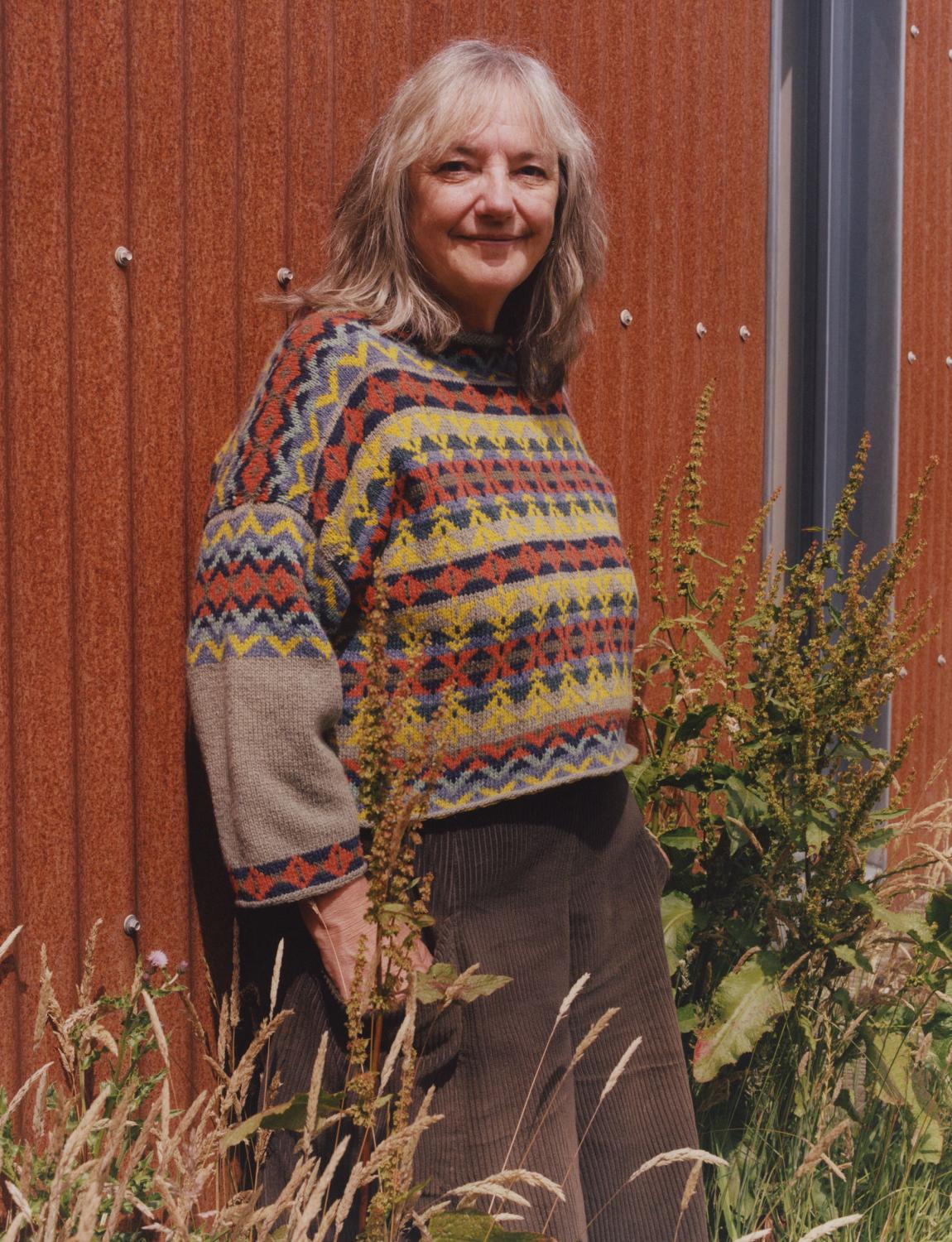
With a pair of size 8 needles and £50 worth of yarn, Di Gilpin set off to conquer the world of couture knitting, working with everyone from Connolly to Ferragamo. But what drives her is the sheer joy of what knit one, purl one can do. With Channel 4’s forthcoming The Game of Wool, hosted by Tom Daley, Di, 67, hopes to get the whole world casting on.
“I’m a natural experimenter, and I really like to push boundaries.” Di Gilpin – designer, knitter, businesswoman, author and researcher – is one of the foremost craftspeople in her field, revered in the knitting community from New York to New Zealand, and the fashion world’s go-to creative for extraordinary couture knitwear. Now Di is about to become a household name as a judge on the forthcoming Channel 4 show The Game of Wool – a kind of Great British Sewing Bee for knitters, with the Olympian and knitting enthusiast Tom Daley as its host.
I meet Di in her rustic workshop, the headquarters for her yarn and knitting business, Di Gilpin Ltd, at Comielaw Farm – part of the 2,000-hectare Balcaskie Estate in the East Neuk of Fife, a 20-minute drive south of the university town of St Andrews. She is dressed in a brown Toast sweater (she rarely wears her own designs unless someone else has knitted them for her) and a pair of well-worn, voluminous olive-green corduroy Turin trousers by the slow-fashion designer Terry Macey. Her hair is slightly tangled. Her dog, Loui, a cross between a fox-red Labrador and a poodle, is next to her, checking me out.
A few days before I visited her, Di had hosted a delegation from a white-hot London fashion house. “I’ve always loved fashion. I like that relationship where a designer takes you into their world,” she says. The team was up to discuss a possible collaboration to develop an artist’s work into a hand knit. “They were mind-blown by the process,” she says. Di is a master in her field, Britain’s equivalent of what the Japanese call a “living national treasure”: an artisan who possesses exceptional skills and is honoured as such. No wonder fashion designers are so keen to take her into their world.
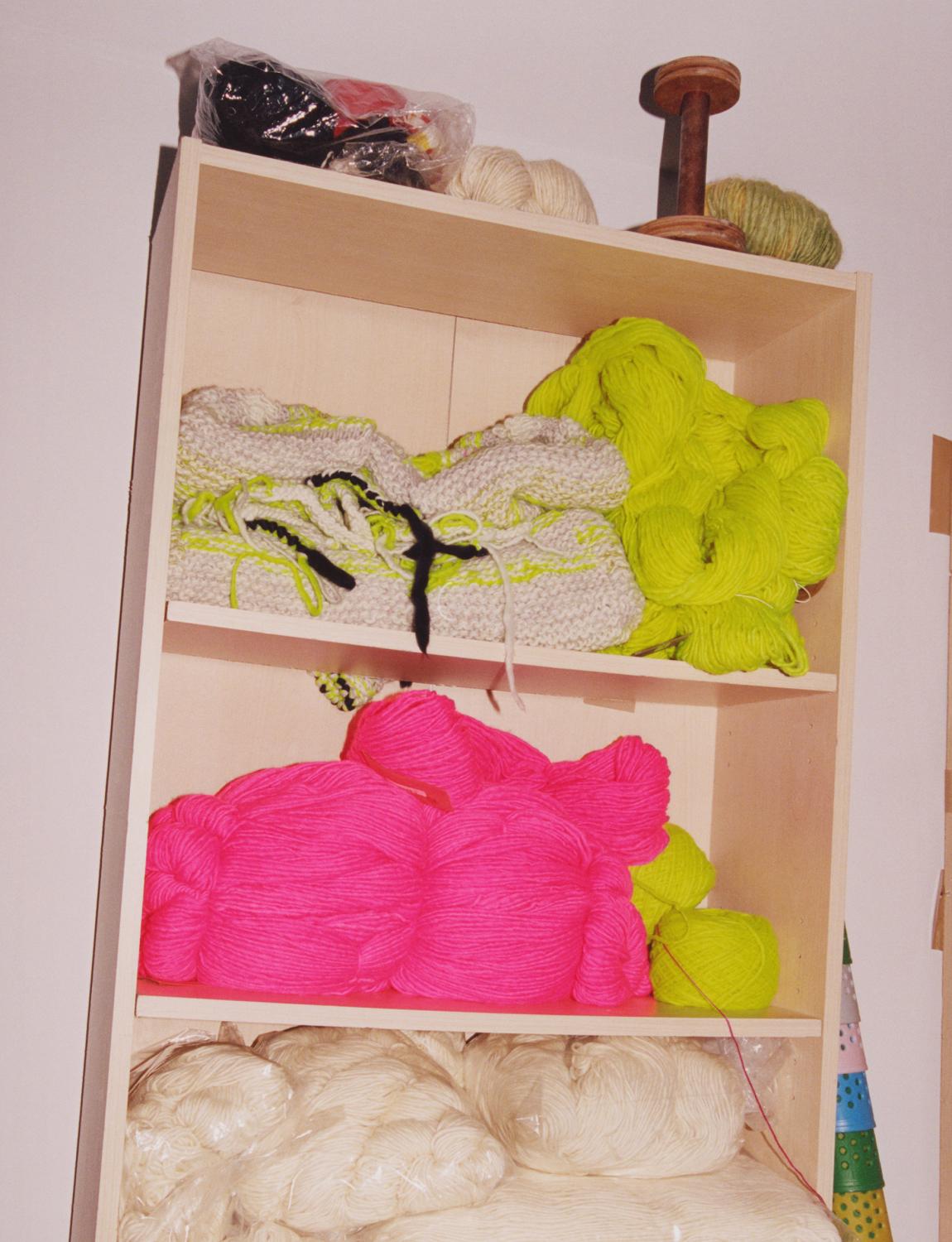
Her showroom/workshop, with an office upstairs, is in an old stone barn, where she also runs workshops on such knotty matters as finding the right tension, experimenting with colour, and how to knit a pattern that uses unusual combinations of stitches and techniques. There are mannequins wearing her designs, including complex Fair Isle slipovers in colourways that include Sea Glass (blues) and Northern Lights (pinks); a rail with samples knitters can try on to see if a style suits them before investing in the wool; and balls of her own yarns in delicious hues. An old-fashioned haberdashery display case is filled with her archive of samples, experiments and the odd exquisite jumper made for her son, Robbie Ealand, now 32, before he decided at the age of seven that he was allergic to wool because it made him itch (Di tells me his schoolmates had been teasing him because of his knitted wardrobe). This “cabinet of curiosities”, as Di calls it, features on her regular YouTube show: in each episode, she and her production manager, Sheila Greenwell, pull out a drawer and share the contents and the stories behind them with their avid followers, knitters and wool enthusiasts from all around the world.
The cabinet of curiosities is precious, a testament to a lifetime of innovating and playing with knit. (Every two years, for fear of moths, she empties out the drawers, wipes them with a mix of camphor and lavender oils, and places their contents in the chest freezers of the 17th-century Balcaskie House.) Di has more than 40 years’ experience. She has written two pattern books, Shore Lines: Inspirational Knitting (2005) and The Gansey Knitting Sourcebook (2021, with Greenwell). At the Harris tweed mill in Carloway, Isle of Lewis, she developed a classic yarn for the wool giant Rowan using traditional spinning and dyeing techniques, and she has developed
two yarns of her own, a limited-edition Scottish merino called Bell Wether and a lambswool called Lalland, which she sells internationally online as well as in specialist shops. Her knitting
retreats sell out as soon as they are announced in her newsletter, and she is a popular guest on the fibre-arts social network Ravelry.
Hand knits are a real luxury. It is not just the cost of the wool. A 50-gram ball of Bell Wether, dyed and spun by Laxtons mill in Yorkshire to Di’s specifications in a deliciously soft yet vibrant colour palette – “my favourite is Ballet Pink, which has taken years to achieve” – is £15.75. The best-selling Carrington jumper, knitted in Lalland (£13.75) and dedicated to the artist Dora Carrington, uses seven to nine balls. You also have to factor in the development of the design itself, the time taken by Di’s trusted team of skilled knitters, and the finishing, the point at which all the knitted pieces – body, sleeves, bands – are sewn together, by hand. “Di and I do all the finishing,” Greenwell tells me when I meet her at a workshop on multicoloured cabling the following day. “So it’s always the same neckline, it’s always the same person sewing up. It’s so that it is really consistent.” You can understand why they are particular about the projects they choose to work on. “We do charge quite a lot for the making, and we do incorporate it into the price of the first sample,” Di says. “The element that’s not added in when people are working out the cost of something, the price of something, is that element of the handmade, the love and attention that goes into it. When people put something on they feel the hand of the knitter. The fabric is energised by the human. It’s not the same if it’s made by machine.”
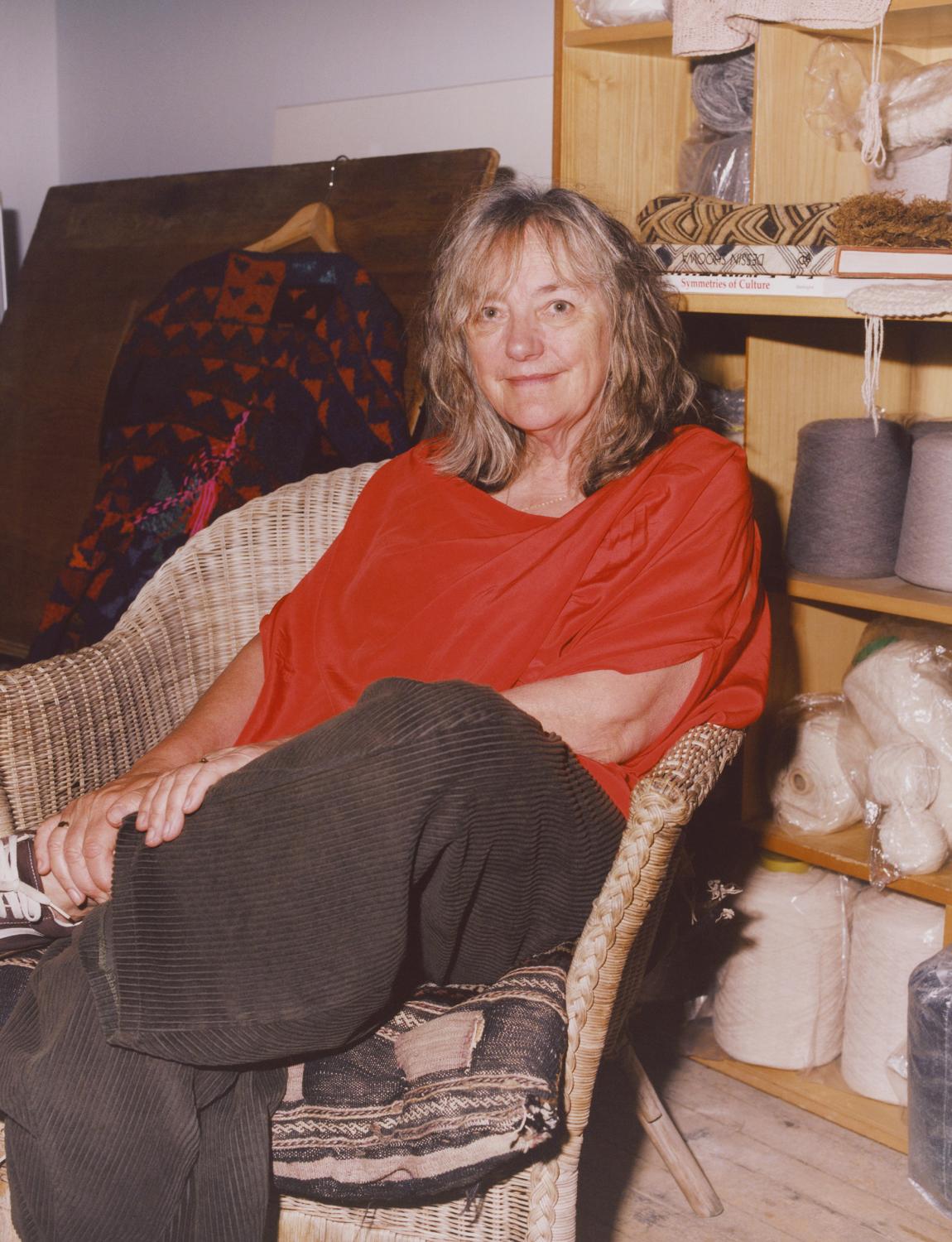
Di was photographed in and around her workshop on Comielaw Farm, in the East Neuk of Fife. On these pages she wears her own clothes, including, on page 202, the Cairngorm Fair Isle T with Sleeves jumper, knitted from her own Lalland lambswool.
The company employs eight core knitters, with a roster of other knitters on call – Di mentions an epic 2011 commission for the London design duo Meadham Kirchhoff, the hottest ticket in town at that time. Di and a team of 35 knitters, working day and night for four weeks, created more than 40 pieces using complicated traditional gansey patterns, everything from socks and skirts to complete dresses precision-knitted to fit. “I love pulling together little miracles,” Di says, smiling. But she also turns away a lot of work. “We do very selective projects which we know are going to be well enough paid,” she says.
And she has many such projects on the go, including a small capsule collection of her favourite designs that she is planning for her website. Current collaborations include one with the London-based menswear brand Harry Mundy, for which she is making a few pieces using Uist Wool, a social enterprise working with Hebridean sheep. And there is an ongoing partnership with Isabel Ettedgui, the creative director of the luxury brand Connolly. The week after we meet, they will go into production, revisiting some classic oversized Joseph knitwear from the 1980s. Then there are the special orders – all Di’s own designs can be custom-ordered online. The bestselling Arabesque gilet that falls from a generously cabled neckline into deep rivulets and fluid channels designed to emulate the way streams travel down hills can be knitted in Lalland wool in six to eight weeks.
The yarn, the designer collaborations and production, the patterns, workshops and retreats, and the festival Di is planning for November fuel a healthy business. In addition to the knitters, there are six members of staff working across development, distribution and fulfilment, and there are plans to expand into a bigger space at the farm.
“Hand knit is so extraordinary. One piece can raise a collection – just one piece.”
Di started knitting when she was three or four. She was taught by her mother, Dorothy, and her “Aunty” Doris, a friend of her mother’s; they had worked together in a Hurricane fighter plane factory during the Second World War. Di’s father, Craven, was a caravan manufacturer who had run away from a private school in Scarborough to become a motorbike test pilot and mechanic. The family lived in Beverley, east Yorkshire, close to where Doris and her companion, “Aunty” Beryl, lived with Beryl’s parents, Mr and Mrs Flather. Bourne End, their grand Arts and Crafts house, was “full of amazing things”, Di says, with tennis courts and extensive gardens. In the summer holidays, she would stay there; friends of Beryl and Doris would visit, and there would be dinner parties where everyone would dress up. “I got to ring the gong for dinner,” Di says. “From a young age they treated me like a grown-up. I used to stay in the blue room, which had blue quilts and these massive wardrobes.” One wardrobe was lined in blue velvet and was full of couture dresses Beryl had worn as a debutante – hand-painted flowers on organza, all sorts of finery. The other wardrobe housed fur coats. “It was a bit like The Lion, the Witch and the Wardrobe going into the wardrobe, and rather than coming out, the world was in the wardrobe. And I was just fascinated.”
Mr Flather invented generators and had worked with Louis Renault on car engines. “They had a miniature Renault car they used to set off and it would go around the living room.” And there would be creative afternoons in the library. “We’d sit and knit. Aunty Beryl would put on a gramophone and dance with a sherry in her hand.” (Di was included in sherry time from the age of eight. “It really was from another planet.”) For two weeks each summer Doris would take Di to London, where she would accompany her on appointments to couture houses and ateliers to have opera gloves made and commission dresses. They would have tea at Claridge’s. In Beverley, Di spent her childhood with ponies and horses. “I was wild; they couldn’t get me in to school. I’d be off on my pony down the lanes with a little backpack.” Alongside his luxury range of caravans, her father built bespoke caravans for “folk travelling with the circus – Coco the Clown, for example. I helped with the carpentry and designing the interiors, choosing the fabrics.” Inspired by Doris’s tweed suits, she remembers saying to her father, “‘We need to have tweeds.’ So he got all these tweed samples. We were the first caravans to have contemporary tweed with real wood.”
Learn everything you need, whether beginner or knit pro (starting with an introduction to yarn types, weights, tensions and behaviours), at Di’s workshops, bookable on her website. Coffee and cake will be served.
Di studied history and politics at Warwick University, knitting through her lectures because it helped her concentrate. “I was really interested in the concept of revolution – how the world changes, like through art or through music, or where you see ripples of something happening, and then how that translates into political thought.” She went on to teach English and history in a secondary school in Warwick until she had an accident in 1981.
Two years later, Di and her then boyfriend, Chris Ealand, moved to the Isle of Skye, off the west coast of Scotland. They hitchhiked, taking nothing but a tent. Di’s backpack contained £50 worth of wool and her trusty knitting needles – and a pair of new Scarpa hiking boots she had bought using a small inheritance from her eccentric Uncle Jimmy, a wealthy relation of her father’s. Di told me Jimmy would swim every day off the coast of Scarborough and pay a
fisherman to pick him up a mile out and bring him back. He had a pair of shoes or boots for every day of the year. The £500 inheritance was, he instructed, to be used to buy a pair of walking boots with which to explore Scotland.
She and Chris found a semi-derelict cottage in Eabost in the far northwest; a cow had been living in the front room. “We were there for five years, and there was no electricity.” They did eventually put electricity in the front room. But there wasn’t a bathroom. Chris opened a bike shop, Island Cycles, and she knitted to commission.
The winter days on Skye were short and the nights long and dark. “We had paraffin lamps. And you’d be knitting and not really seeing. So you create these little formulae, and if it was colour work I used to sing it. I’d have a note for one colour, a note for another and a note for another. And so you’d have the colour changes and then the numbers.” She starts to sing. “123 123 123 123 22.” What she was knitting in the dark might have been full of mistakes, “but usually it was absolutely spot on,” she says. “What an incredible thing our human brains are.”
Knitting became a means to survive, both financially and psychologically. “It took me out of the place that I was in, which was very dark, and gave me light. And then I saw that it does the same for everybody who picks it up.” She tells me about a time, 25 years ago, when she taught a woman who had been “anxious about signing up for one of my retreats because she said she didn’t have a creative bone in her body. After learning to knit she quit her high-powered job in London and started a whole new chapter.” Life on Skye was simple and remote. But there was a local creative community, including Kathleen Lindsley, a wood engraver, who had set up Raven Press Gallery in 1976. Lindsley’s work inspired Di’s own textural knits, and it was she who designed Di’s logo, a lovely engraving of a bellwether Jacob sheep (a bellwether is a castrated male with a bell around its neck, kept with the flock so the shepherd knows where they are).
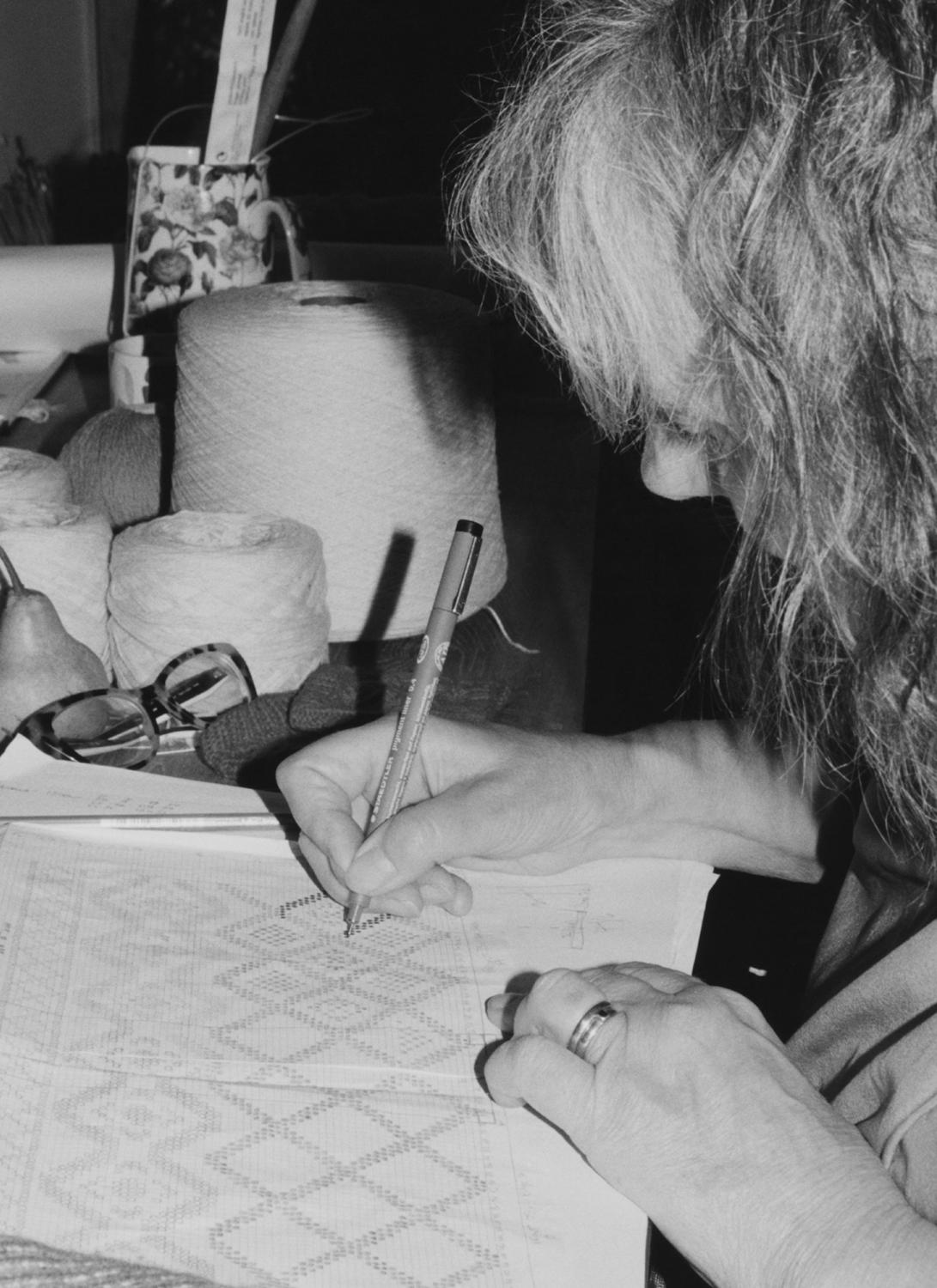
Di started to create patterns using the 3-D relief approach that Lindsley was using for engravings. “She has these tools with a wooden end, with the tiniest different shape to the ends on the metal,” Di tells me. “Each one would make a tiny mark in the wood, and it’s in the negative. So what she left became the black ink, and what she took away was where the paper would be seen. And then there were these half areas where a tiny bit of ink gets absorbed, just enough to give shade.” Di uses the same principle to denote relief and dimensions in her knit, using pencil and paper rather than wood. “All my patterns I make on graph paper.”
Di loves nothing more than when knitting is used in unexpected or nontraditional ways. She is not a fast knitter, rather interrogating every stitch she makes. When Nike was investigating the use of knit for a new generation of garments and shoes for the US team to wear in the London 2012 Olympics, it was Di, with her knowledge of traditional gansey fishermen’s knits, who convinced them that knitted textiles offered more flexibility than woven. (Her Moray Firth project
Fishing for Ganseys documents, preserves and keeps alive the traditional gansey fishermen knitting patterns along the east coast of Scotland with a historic collection kept at the Scottish Fisheries Museum in Anstruther.) The Flyknit shoe was launched that year, revolutionising trainer technology. Her knowledge also resulted in the Library of Knit, sponsored by the Joseph Ettedgui Charitable Foundation at Dumfries House in Ayrshire as part of the Prince’s Foundation and created to inspire other knitwear businesses like hers. King Charles, the patron of the Campaign for Wool and Wool Month, a series of UK-wide events that happens every October, will be glued to his TV when The Game of Wool is screened: when he met Di at a royal garden party at Holyrood in July, he asked, “You will let me know when it’s on?”
“When people put something on they feel the hand of the knitter.”
Di left Skye in 2000 when she realised that Robbie, then seven, needed more interaction than the island’s tiny school could offer. She moved to St Andrews and subsequently ran a wool shop. It was there, in 2011, that she met Sheila Greenwell, who bought a pattern featuring an abstract interpretation of the surface of the sea. “Sheila saw what we were doing and said, ‘Can I help?’” Once they realised how her technical skills could anchor Di’s creative imagination, Greenwell slowly started doing more and more. “Her organisational skills are phenomenal,” Di says.
It is Greenwell, white-haired, razor-sharp and technically brilliant, who translates Di’s mind-bending patterns into something that can be reproduced by their team of knitters. Di does the technical sizing and tension stitch work, writes the pattern and, if it is a hugely challenging piece, knits the sample. But Greenwell is the main point of contact for the knitters. “I need people who are happy to knit the same thing in succession,” Greenwell tells me, “someone who will knit the whole of the limited edition of one design – two small, one medium, one large.” Developing a piece will involve constant check-ins, putting it on the mannequin to see if it is correct.
Di and Greenwell teach workshops together, deve-lop patterns and commissions together, and co-wrote The Gansey Knitting Sourcebook. When I attended the Schiehallion technique workshop – a colour cabling masterclass, “quite brain-teasing,” Di says – the attendees, many of them regulars, hung on Greenwell’s every word regarding technical challenges, and there are many in the Schiehallion. The technique, Di’s own, is remarkable not just for the combination of stitches but the way Di uses knitting to shape a garment. She is both creating a textile and adding shape and fit. The original idea was based on a painting by Dora Carrington of the mountains in Andalusia, where, from 1985, Di had a townhouse. “I wanted to get a feeling of painting into knit. So I sat down with a load of yarns and played.” She made a hat in rich shades of browns, reds, yellow ochres. Di advises knitting “two lighter colours offset with two darker colours and two brighter colours. In Skye you’d see heathers, dark brown bark and branches, and then bright pink heathers and the zing of an orchid. It tells you what you need to know: the dark, the light, the colour attracting the bees in.”
Elements of this unorthodox mix of cable, Fair Isle and 3-D textures crop up in their collaboration with La Fetiche, a Glasgow- based fashion label founded by April Crichton and Orély Forestier (Tom Daley wears one of their pieces, made in collaboration with Lucie de la Falaise, in the early stages of the show). The partnership has been ongoing since 2017. Their arty knitted pants, cardigans, socks, skirts and jumpers for the label, knitted in zingy colour combinations and often with threads left hanging and seams exposed, can take up to two months to complete. The first project involved adapting a painting of trees by the Swiss artist Nicolas Party into a jumper. It is the sort of project Di loves: working out how to make a knit look painterly, recreating the brushstrokes and the texture of oils on canvas. “Hand knit is so extraordinary that it can do things that are beyond what designers imagined,” she says. “One piece can raise a collection – just one piece.”
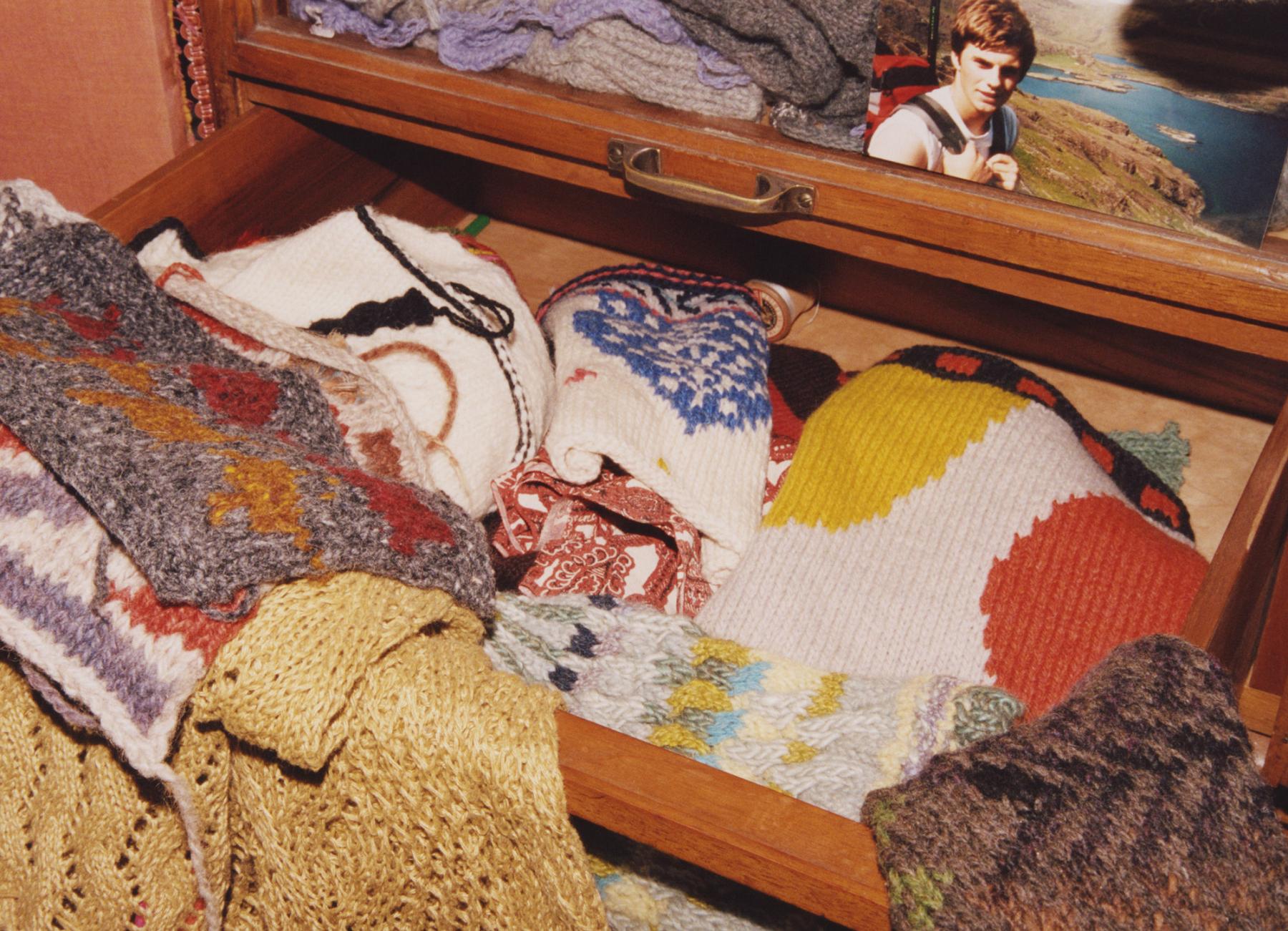
To avert infestations, Di empties her “cabinet of curiosities” every two years. The contents – including her archive of samples as well as more sentimental creations – are frozen in chest freezers and the cabinet wiped down with camphor and lavender oils. Not today, moths!
Once The Game of Wool is broadcast this autumn, Di’s extraordinary work will no longer be the preserve of in-the-know fashion houses and knitting enthusiasts. She and Greenwell spent nine weeks filming the show in Ayrshire. Di judged the contestants’ creative endeavours, Greenwell their technique. They were “all competent knitters,” Di says, “and some with great ambition – you really see it.”
They first met Daley in a studio near Heathrow. “Sheila said to him, ‘I thought they were going to arrest Di because she had her knitting on the plane.’ And he pulled out his knitting bag. He had been knitting a sleeve. He literally knits a whole garment on the plane from LA to Heathrow.” From that moment, it was obvious that the chemistry between the three of them was perfect. Di and Greenwell appreciate the fact that Daley understands how knit works. He is, Di says, typical of a new generation of knitters who taught themselves on TikTok. “He’s inventive, and he’s got such a passion to learn. Nothing escapes him. And he knits all the time. So his hands have become very fluid.”
The two women are a wonderful double act in The Game of Wool, old enough to be Daley’s grandmothers, with all the knowledge, wisdom and experience he and a new generation of knitters are hungry to receive. “Sheila and I have a great working relationship,” Di says. They have the perfect combination of design and technique. “We didn’t want Sheila to become the super-critical one on the show,” Di says. “I kind of bounce in and always say, ‘I love that.’ That’s my nature, that I never want to say anything negative. But sometimes you have to be like, ‘This isn’t right. You’ve crossed your stitches. You will never be able to knit a straight fabric until you relearn this.’” Since filming ended, Di has been mentoring two of the contestants, and she says she might ask one to do some pattern writing.
As well as knitting, Di likes certain branches of mathematics, such as trigonometry. “Maths is the key to every-thing,” she says. “I’m good at numbers, sequences. I love numbers, and they do make me quite tearful at times. I instantly know when something is right, because it’s all about tension and number of stitches – you’re making fabric and form at the same time. There are magic numbers, sequences that are magical.” This feeling for numbers is something of a superpower, but it seems quite normal to Di. “Maths is so beautiful, it never ceases to amaze me,” she says. It is, she adds, “a form of plain theory. So you start with a regulated pattern, and then you go into a meditation almost, and your mind, your brain, works out where everything should go.”
Di shows me some of the charts in a plan chest in her office. They have their own vocabulary of symbols, each denoting changes in stitch, texture or direction. As in the landscape itself – a stretch of coast, a drystone wall, a patch of heather – there is no set pattern. (A knitting machine programmer once told her that making a program for one of her pieces would cost £20,000, it was so complex.) She builds irregularities into her work. “It’s thinking out of the box all the time. Never take it on a straight path.” She tells me that when she saw how the weaver Anni Albers planned her work on paper, it reminded her of her own charts.
For now, Di sees an opportunity to use her new profile to get more people knitting. She would like knitting put back on the national curriculum in Scotland, as it was when Greenwell was at school. “If we can persuade the Scottish government to put knit back on the curriculum and tie it in with maths, with English, with pattern writing, with working together, we could aim for that.”
And it’s not just knitting, it is the wool itself. “Plastic yarn is killing the planet,” Di says. Rather than use polyester yarn, which is cheaper and more accessible than wool, she suggests recycling old woollen garments and reknitting them, as she did when she started. “I want to get people knitting first but then for them to understand where the fibre comes from, how it’s grown, what the sheep eats, how it’s produced, and to see that the farmer gets a really good return for the fleece, so that farming continues.” Wool is an incredible material, she continues, “and if you are vegan, there are farms now that are not killing their sheep but using the wethers and taking the fleece from them, because wethers produce better fleece than ewes do. Because with ewes, a lot of their energy goes into
milk production.”
For Di, knitting is transformative. It can bring communities together, support mental health, and foster an understanding of slow fashion, sustainability and regeneration and of nature, heritage, craft and history. It can teach us maths and critical thinking and provide a source of income. Ultimately, though, knitting is pure pleasure. And that, more than anything, is what motivates her. “When people watch The Game of Wool they will find somebody light-hearted,” she says, “and I think we need to cheer the world up with something that is fun and creative. Because knitting is a source of joy.”
Tamsin BlanchardThe fabulously erudite Tamsin Blanchard is one of fashion’s most esteemed writers and activists, advocating for greater sustainably before the term was even coined. She is a member of Fashion Revolution’s Global Coordination Team and is the curator of Fashion Open Studio, two pathbreaking organisations…read more Portraits by
Rachel LambBorn in Glasgow, Scotland, Rachel now works between London and Paris. read more