Danya Jimenez & Hannah McMechan
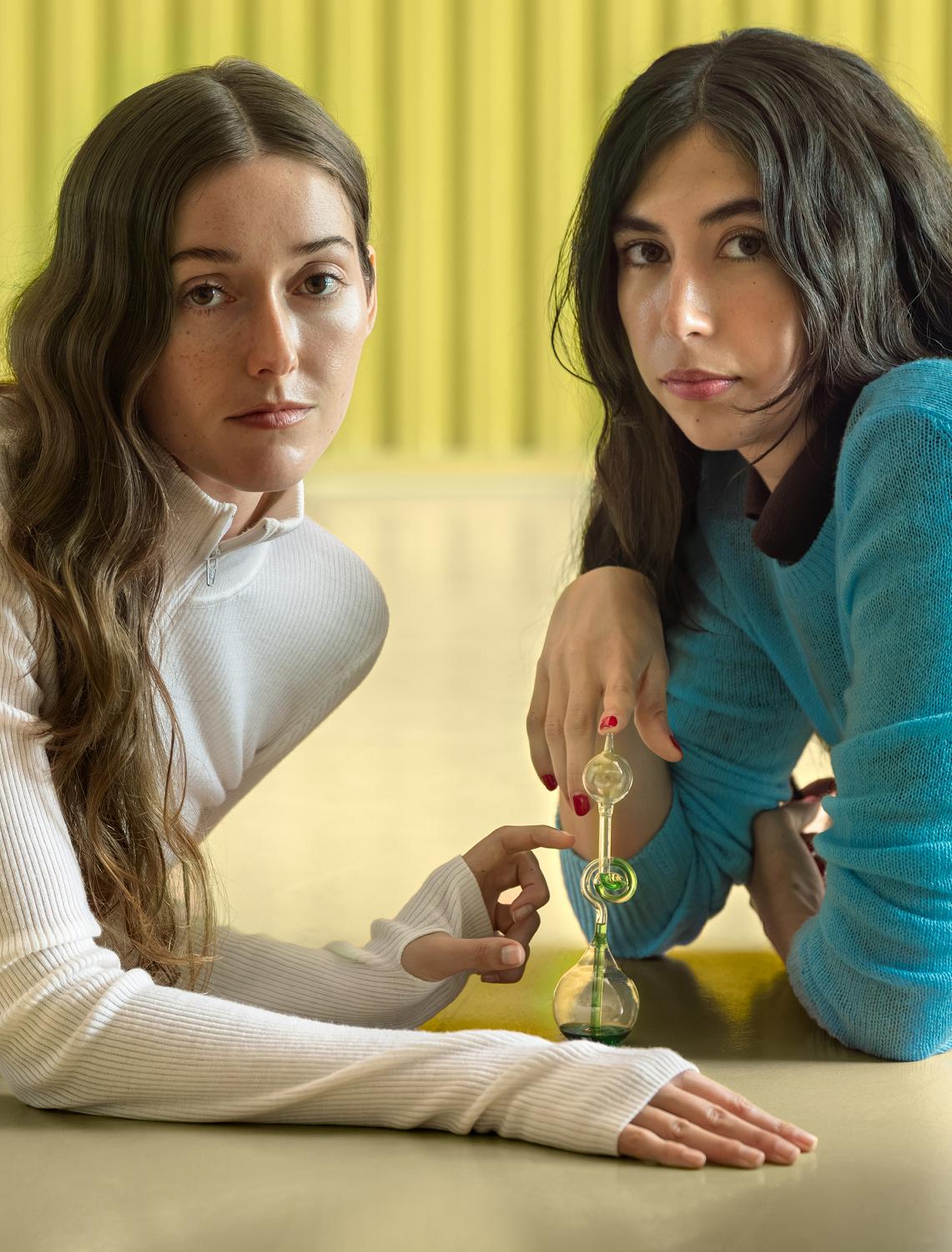
The neighbourhood shipping and mail shop on Hillhurst Avenue in Los Angeles has just opened for the morning when Danya Jimenez and Hannah McMechan pull up outside. The powerhouse screenwriting duo, best known for KPop Demon Hunters – which amassed a colossal 600 million views in its first 12 months on Netflix alone – has arrived in Hannah’s beaten-up beige Subaru Outback. Both women are wearing low-slung jeans and flats, their hair (Hannah, blond; Danya, brunette) hanging past their shoulders.
Other writers have home offices with HP LaserJets, or even assistants who fetch their in-progress scripts from the local FedEx. The team behind Netflix’s most-watched film ever has CopyCat, where Danya still likes to have their drafts printed and stapled. Then coffee is picked up, and work commences at Danya’s apartment in Silver Lake, eastern LA, 10 minutes’ from Hannah’s in Echo Park. But first she prepares an elaborate breakfast for both of them – and now for me.
Her artfully composed plates of soft-boiled eggs, fresh fruit, salted tomatoes, Parmesan-blanketed rocket and toast fuel their increasingly long working hours. Since KPop became a sensation, their first live-action feature, Youth Juice, a horror satire about ageing on which they are both producers, has finished shooting in Los Angeles. Warner Bros has hired them to write the director Tim Burton’s reimagining of the classic 1958 film Attack of the 50 Ft Woman. (Margot Robbie is attached to produce and star.)
Danya, 30, who was born in San Diego, but lived in Mexico for a few months; when she was five, she moved with her parents to Orange County, about an hour from Los Angeles. Hannah, 30, was brought up in a town just outside Yosemite National Park so small that its police force consists of a single cop on horseback. They met as undergraduates at film school in 2014. The project that became KPop found them not long after, when its creators, Maggie Kang and Chris Appelhans, hired them to build out its universe and crack the voices of its central characters: Rumi, Mira, and Zoey, members of a K-pop girl group that hunts demons in its spare time. Part of the reason it was such a triumph was because it felt real; the preoccupations and interests of teenage girls – fandom, flirtation, Korean instant noodles – so accurately depicted. Plot twists leaned on the supernatural. KPop won two Oscars in March. Danya and Hannah attended the ceremony, months after wrapping work in Texas on Brothers, an Apple TV comedy series starring Woody Harrelson and Matthew McConaughey as semi-fictionalised versions of themselves that premieres this autumn.
It all sounds glamorous, and it is, except when the power flickers out in the Silver Lake kitchen because more than two appliances have been plugged in at once. The darkness lasts a split second. Then both women groan and laugh.
M –– You met in college. Were you immediately like, “It’s love”?
D –– I think we met in the first two weeks.
H –– It was a fast burn for me. It wasn’t as fast for Danya. She always says I looked like Miley Cyrus on a beach cruiser. I was this blond country bumpkin from Yosemite. She was the opposite. But I’m drawn to hard-to-get people. I wore her down.
D –– It took me longer. The people felt just like the people I had grown up with. I thought the scene would be a little more LA. Grungier. Instead it was like high school. Then Hannah walked up to me. I took one look at her and I was like, This is just not going to work.
H –– So rude! So rude!
M –– Did you try writing with other people before you wrote with each other?
D –– I didn’t.
H –– I guess I did in college; I co-wrote a lot of my friends’ thesis films and those actually got made, so that was cool.
D –– It’s about taste. It has nothing to do with other people’s writing capabilities. It’s like, Oh, we turn out to agree on a lot of things. We both loved British TV a lot. Skins, obviously.
H –– And Misfits.
D –– Which is a very random show.
H ––The Inbetweeners. Fleabag, but that was a bit later.
D –– We also liked some of the same movies.
H –– We were such Juno girls. We loved Little Miss Sunshine. Those small movies that went to theatres, which happens so much less now. Back then, a premise would be “Michael Cera has a night around town.” And that movie sells at Sundance for millions of dollars.
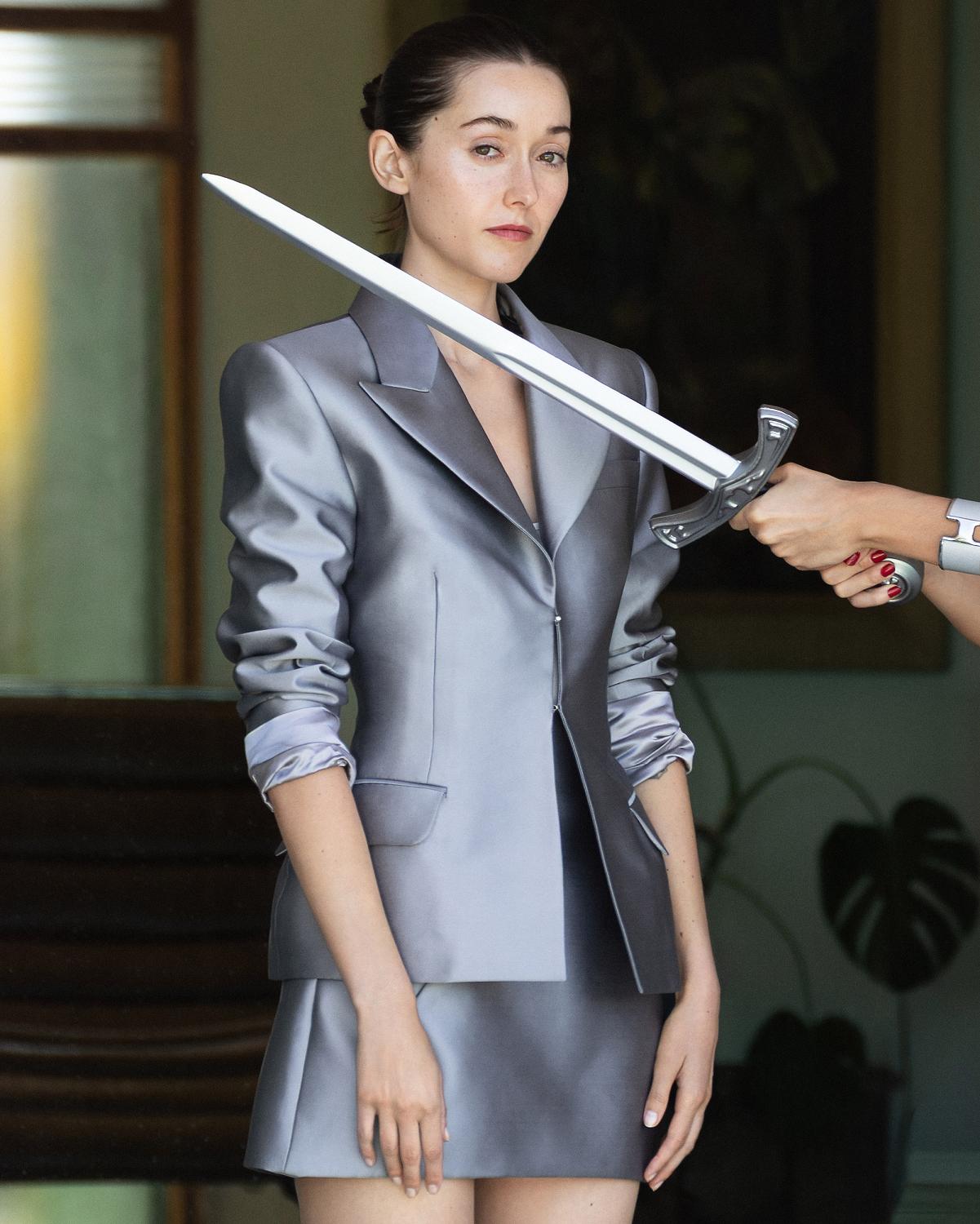
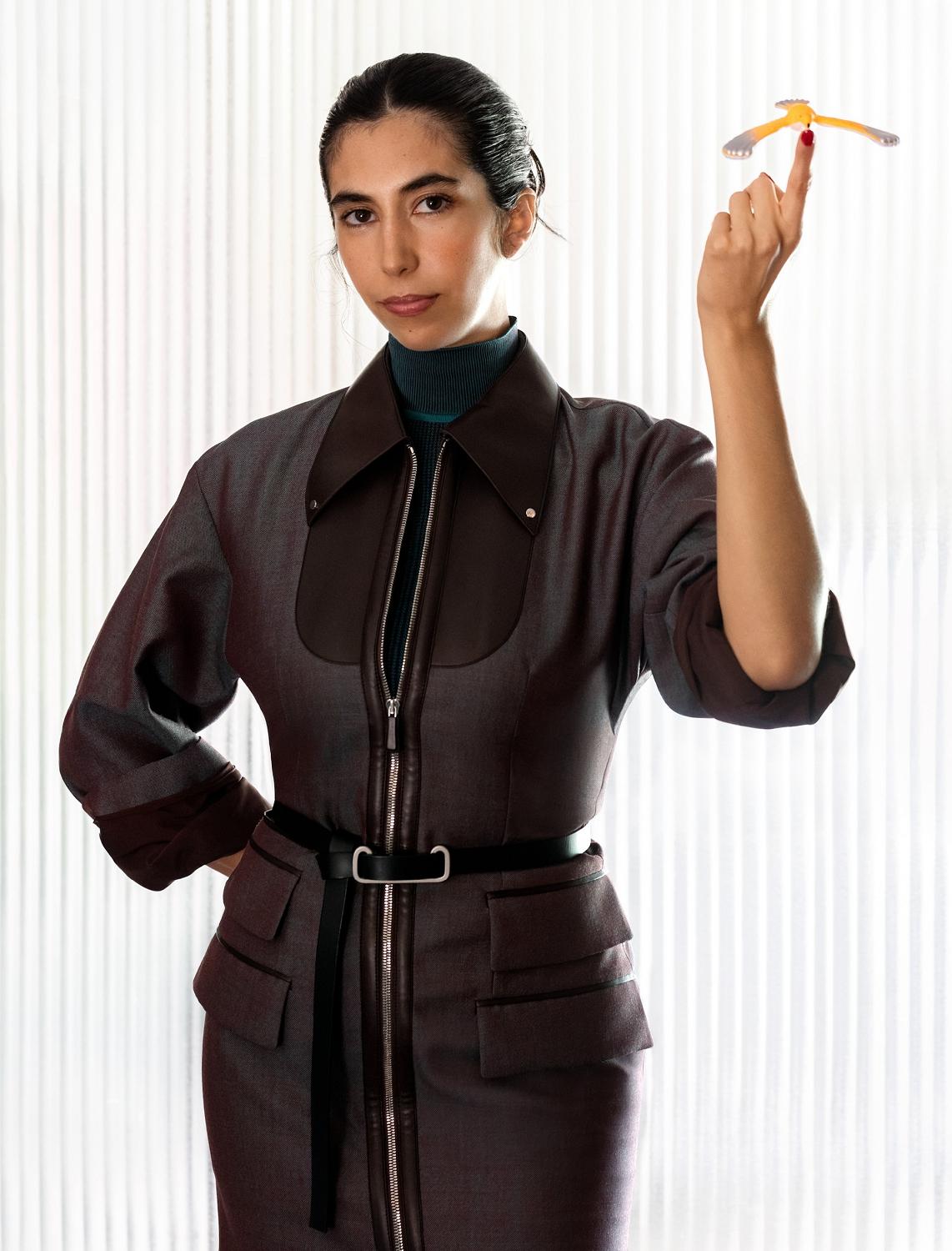
Hannah is in a silver silk jacket and miniskirt by McQueen. Danya is wearing a deep-red wool-and-mohair dress with lambskin details and a malachite-green micro-jacquard wool-and-silk top, both by Hermès. The black leather belt is by Issey Miyake.
M –– When did you both know scriptwriting was what you wanted to do?
D –– Since high school, but I didn’t really understand that I could do it. I would watch so much TV, and I would write really angsty stuff. But it wasn’t until I had to figure out what I wanted to do for college that I realised it was a job. I saw the movie No Strings Attached with Ashton Kutcher. He plays a production assistant. I said to my dad, “Ashton Kutcher’s job looks incredible.” He was like, “You know, you can do that for work.” I was like, “No fucking way.” So I looked into it, and you could.
In 2017, the year before they graduated, Danya and Hannah were accepted into the Women in Film x the Black List Episodic Lab, a four-week crash course in script development, pitching and workshopping that offered a chance to find representation.
M –– Was that the first big break?
D ––Yes, but getting representation was not a guarantee. We cold emailed pretty much every assistant in the industry. Only two people responded. One said, “No, thank you.” And then the other one was like, “Let’s meet up and talk.”
H –– We pitched him all these scripts, ideas that we acted like we had written. And he was like, “OK, perfect. Send one of those to me.” And we were like, “Totally, no worries! We’re just going to quickly do a pass and we’ll get it back to you.” And then we headed for the diner to write it! We sent him four TV pilots before he signed us, all very different – a mockumentary, an historical fiction piece, an absurdist, magic realism buddy comedy, a dystopian fantasy thing…
M –– What does writing something together look like?
H –– Here, we put whatever script we’re working on on the TV so we both can see it. One of us types. The other sits and stares at the TV and weighs in.
M –– Is one of you better at typing?
H –– Danya is better.
D –– It depends. If we have a lot of time, Hannah can do it.
H –– The problem is I cannot write a sentence unless I’m like, That is the best possible version of that sentence.
D –– Versus me, who is just, We’re going to edit this a thousand times, so it doesn’t matter.
H –– I want to be more like that.
D –– She has the brain of an editor, and I don’t. We get in little tiffs about that, but that’s basically all we fight about.
M –– When you’re preparing for a project, are you reading, watching movies? How do you get into the world?
D –– We really do just write what we know. Or at least people and characters that we know. There are sometimes situations that we have to research.
H –– But it’s like, with KPop, we’d been teenage girls. We’ve been best friends, co-workers, women in our 20s. We have done those things.
M –– Has your communication got better over the years?
H –– What is that expression? It’s not about the rupture, it’s about the repair. I feel like our ruptures have stayed the same but we’re able to move past them with a lot less heat than we used to.
D –– Thank God for that.
M –– This partnership is like being in a relationship, but it’s also your entire career.
D –– Our lives are so intertwined.
H –– We have all the same friends, too.
D –– I don’t think people understand. If someone tells me something and then is like, “Don’t tell anyone,” it’s like, Sure, but I’m going to tell Hannah.
H –– We’re together all the time. Our screens are up on a shared TV. If you’re texting one of us about something, we’re both going to see it.
M –– Do you have any desire to do your own projects?
D –– It’s too scary to write alone.
H –– I don’t think it would be as good. Even if I wrote something on my own, I’d be like, “Danya, can you read this and give me notes?” So what’s the point?
“KPop has changed our lives in every single way except materially.”
An early script was Luna Likes, about an undocumented moody Mexican American teenager obsessed with the late chef and author Anthony Bourdain. It earned them a place at the Sundance Screenwriters Lab, where it inspired their advisor, Nicole Perlman, who co-wrote Guardians of the Galaxy, to recommend them to Maggie Kang for KPop. They were just 23 and 24 when Kang hired them over more established writers.
M –– Part of what made KPop so special is that the girls sound like real people and the arc is unconventional.
D –– I think Maggie, Chris and the two of us have such similar tastes in terms of character. We were all on the same page, and we were protecting the same things. Both of them cared to make every single character great and fought for that. We wrote different treatments. We wrote backstories. We got to know them all so well.
H –– The dynamic between Rumi and Jinu was important to us. They bantered. They were kind of mean to each other. It was not all lovey-dovey.
D –– We were never like, “We’re making this for kids.” We were like, “What do we want to watch?” And then it became a question of how much we could get away with.
H –– No cursing. No sex. But everything else was kind of on the table, and we trusted that kids could handle it.
M –– How did you research the cultural references for KPop?
D –– Maggie handled most of the references as she’s Korean. But we did “research” at our end for fun.
H –– Like we exclusively ate Korean food, only watched K-dramas, only listened to K-pop and Korean music, read Korean and Korean American books. Full immersion.
M –– Is there a KPop sequel in the making?
H –– Yes.
M –– People must assume that KPop changed your lives in a material way.
D –– If people knew how much we got paid…
H –– It has changed our lives in every single way except materially.
M –– But it’s not like you’re getting a cut of every Rumi wig that’s sold.
H –– I wish we were even getting a penny.
D –– This is probably too much information, but we were in a contract for box office money. So the fact that we ended up on streaming took a lot of that off the table.
M –– You couldn’t have known what it would become, though.
D –– But our lawyers could have.
M –– Do you have new lawyers now?
D –– We do.
H –– And they are scary people.
M –– You want scary people!
D –– Because we’re nice. I mean, I hope so. But that means people take advantage of us. We’re also young and women.
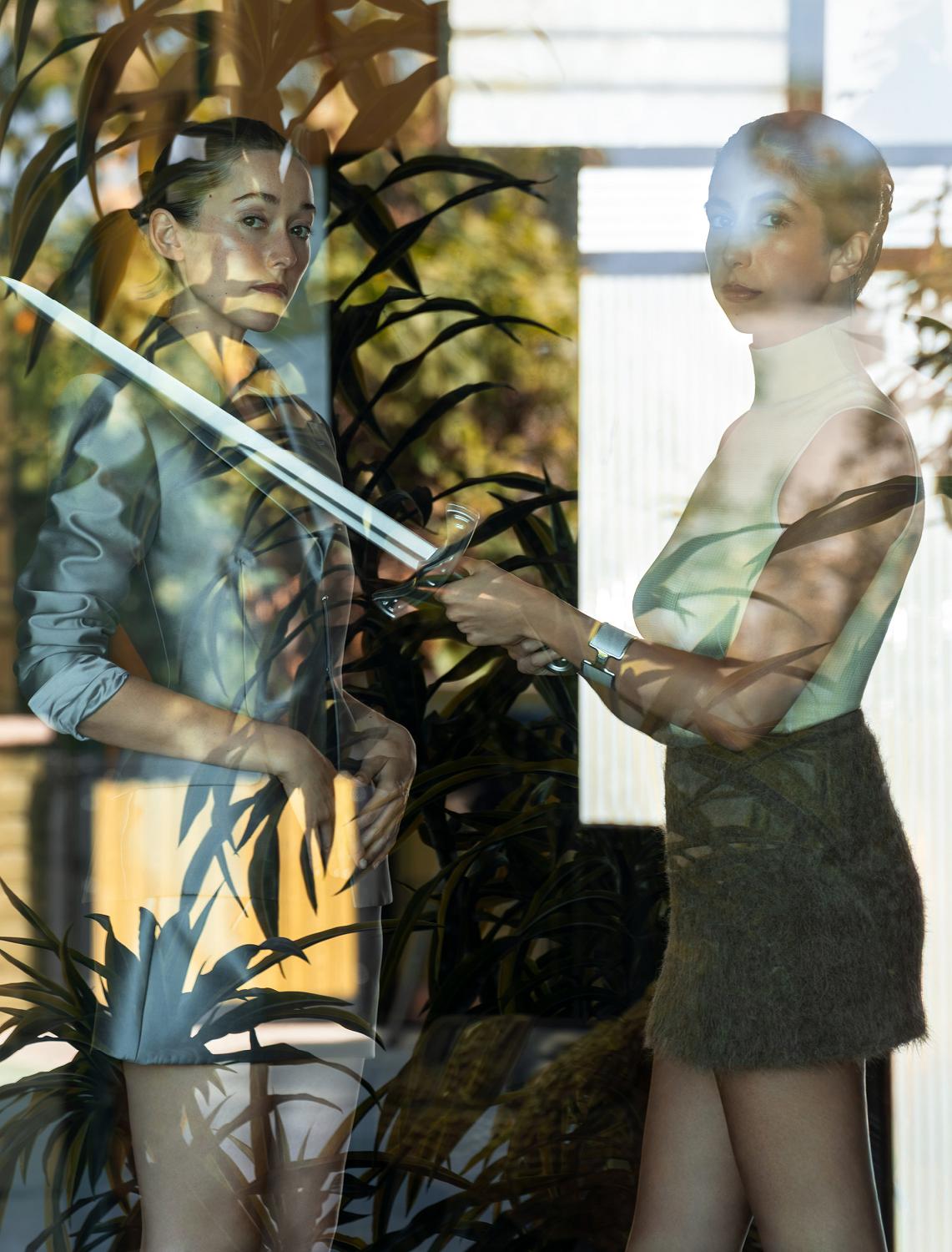
Reunited again: Hannah is in the full McQueen look. Danya wears a yellow wool-and-silk top and a palladium-finish metal bracelet, both by Hermès. The hazelnut alpaca-blend skirt is by PriscaVera.
M –– You wrote on the new Apple TV show Brothers, which stars Woody Harrelson and Matthew McConaughey. Did you meet them?
H –– Yes, daily, during production. We smoked a lot with Woody and experienced Matthew’s otherworldly charisma on the daily.
M –– What was it like to channel men in a script?
D –– That was the craziest experience. It was insane. We had a showrunner telling us, “They wouldn’t say this or that.”
H –– We were in a writers’ room with 60-year-old men, and so we had them filling in some of the gaps.
D –– But even they, these sensitive writer boys who we’re besties with now – they were like, “I don’t fucking know how these guys talk.”
H –– Well, because they’re superstars.
D –– And from that era. Anyone who’s famous from that time has a completely different reality that they live in.
H –– The show is based on their real lives. They’re playing their real selves. It’s not even writing for a character. It was writing for Matthew’s real life.
D –– It was scary, because sometimes you would swing and it would be a hit, and other times you really missed in a big way. They both have this like, internal, instinctual bullshit detector that is really, really on point.
M –– Of course, men have long sat in rooms and been like, “What would a girl think?”
H –– But this was the reverse. And I’m sure people were shocked when we showed up.
D –– We never pretended like we experienced the things we were writing. Men will sometimes be like, “How dare you think that I don’t know the voice of a 14-year-old girl?” It’s like, Why would you want to? It would be weird if you did!
M –– Do you ever feel starstruck?
D –– I think I feel starstruck after the fact. There’s no room to feel it while we’re working.
H –– Exactly. It’s also easier with some people. With Tim [Burton] and Margot [Robbie] I’m not too starstruck, because it’s not like I grew up knowing what he looked like, and we were a bit older when Margot became famous.
D –– Tim is so relatable. He is a creative. He’s behind the camera. Compared to meeting Matthew McConaughey, where I was like, We have nothing in common.
M –– What’s different about working on an animated film compared to a feature?
D –– You get paid on animation like it’s live action, but you’re working as if it’s a writers’ room. It’s a full-time job, with the expectation that you’re not going to be working on anything else while you’re doing it.
H –– In live action, you get a lump sum for the first draft, and that takes a few months. You can work on it whenever. With animation, you get paid a lump sum, but it’s seven days a week, and it can take years to get made.
Despite the business’s reputation for ego and narcissism, Danya and Hannah count themselves fortunate. Their experiences with showrunners and directors have been overwhelmingly positive. On the set of Brothers, they found mentors in the veteran collaborators Brett Baer and Dave Finkel, who wrote on 30 Rock and New Girl. “Everybody has been so good to us,” Hannah says, marvelling. “It’s really strange.” “Actual good humans,” Danya adds. Both are fans of Zach Creggar, the actor, producer and director responsible for the smash horror hit Weapons, and it would be a dream to work with Anna Konkle and Maya Erskine, the creators of Pen15.
M –– You once called yourselves toxic co-dependents. Do you stand by that?
D –– I love that. Are we still co-dependents? Compared to what we were before? No. But to other people? Yes.
H –– We used to shop for groceries together every week. We would be holding hands in the aisles. We meal-prepped together.
D –– Let’s be real; we still do that. But now I’ll get groceries or Hannah will bring them here. I’ll do the cooking. Hannah cleans. It’s the same, but it was weirder and more intense because we lived in the house with a bunch of girls at the time.
M –– When did you move into your own places?
D –– Three years ago.
H –– We were living in our fourth five-bedroom house with our college friends. We had been doing that for almost six years. All of us kind of reached a point of, We are 26. We need to stop having five roommates.
D –– I was like, “I just think I want to live alone. I’m having panic attacks about you guys leaving dishes everywhere. I can’t live like this any more.”
M –– You must all be at different points in your careers, too. And how you deal with jealousy and envy, which must come up.
D –– It does, but also, this is new. KPop is still new.
H –– And I don’t even know if it’s so much jealousy as it is just our schedules now are so crazy and our time is not our own, so we see our friends less. We’re so busy with these projects, and the stress that we’re under is so intense. It doesn’t make it easy to go and hang out with someone on the weekend or whatever. The stakes are so much higher now.
H –– It probably feels like we’ve pulled back from a lot of people. We know that our friends feel we’ve pulled back. But it is just impossible when we’re on deadline to go out. It sounds so dumb, but it is like, if Margot Robbie doesn’t like this next draft, we’re going to fall apart.
D –– It’s good to have each other. If we didn’t, I would have to go to therapy twice a week.
Mattie KahnMattie Kahn is a writer and editor whose work has been published in Vogue, Town & Country, The New York Times and more. She lives in New York. read more Portraits by
Alyssa KazewAlyssa Kazew is a photographer primarily based in Miami, Florida. Her work has been published in AnOther, Interview, The New York Times and Dazed, amongst others. Alyssa is represented by Main Artists.read more
Styling: Devin Hershey. Hair: Ramsell Martinez at Mode Agency using Bumble and Bumble. Make-up: Courtney Perkins at Frank Reps. Set design: Cody Rogers at Born Artists. Photographic assistance: Will Koning. Styling assistance: Eric Jackson Chen. Set design assistance: John Armstrong. Production: Katie Binfield. Special thanks to Sylvia Kochinski.
This profile was originally published in The Gentlewoman nº 34, Autumn and Winter 2026.