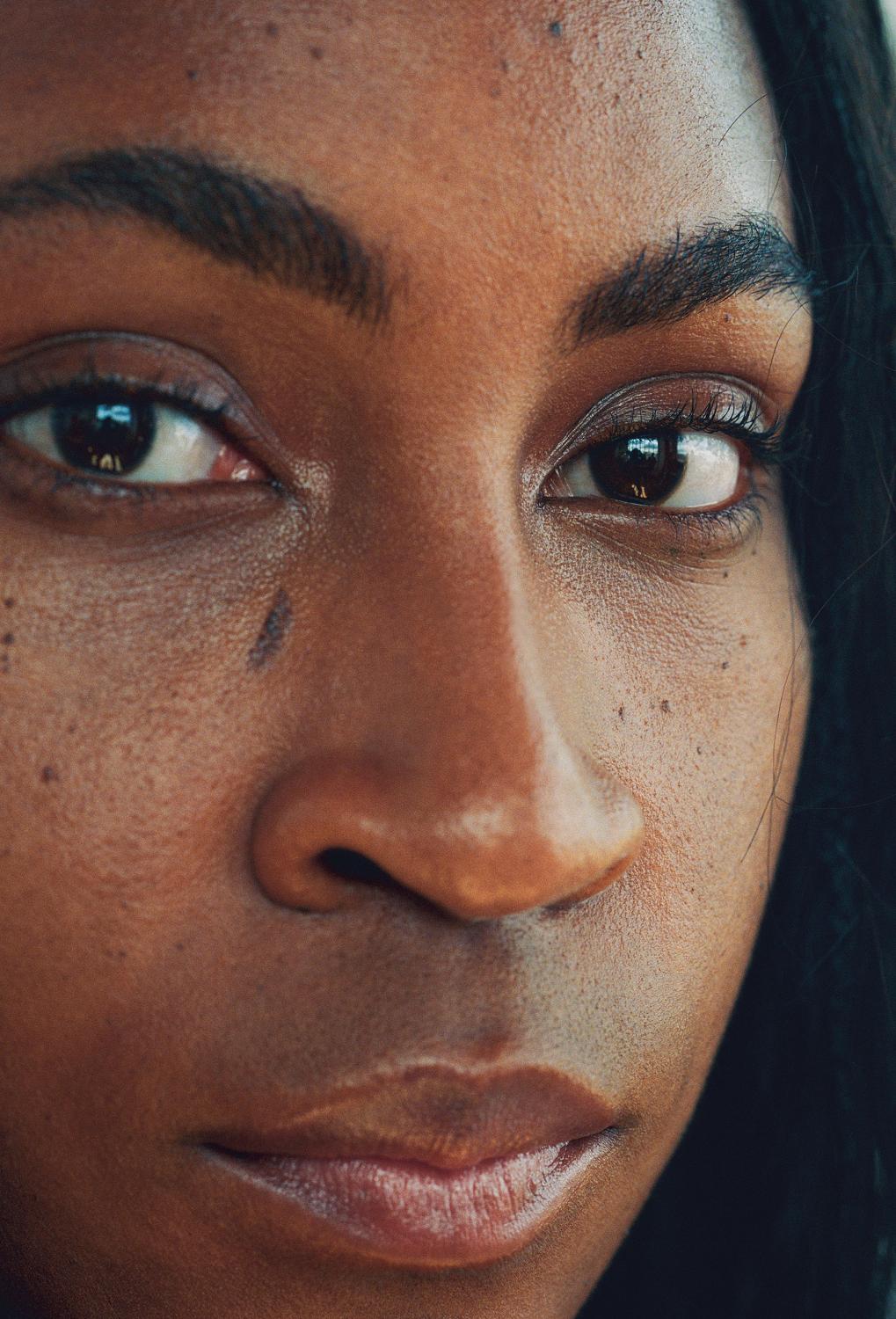
She was eight years old and had just won her first tournament, the “Little Mo” Nationals in Texas, when Coco Gauff decided she would play tennis for the rest of her life. Seven years later, she became the youngest player ever to qualify for Wimbledon, beating five-time champ Venus Williams in the first round and becoming an instant global superstar. Now 22, with two Grand Slams — the US and French opens — under her belt and Cocomania still rampant, the fierce counterpuncher known for her exceptional speed, mental resilience and killer backhand is preparing for an entirely new challenge: taking a holiday.
It’s a strange day to interview Coco Gauff about Coco Gauff. Hours earlier, Wimbledon had announced the final wild card for this year’s Championships: Serena Williams. Suddenly, the only thing anyone in tennis wants to talk about – Coco included – is Serena Williams.
But odd though it is, it feels right. Coco’s and Serena’s stories are as tightly interwoven as a set of strings. The Williams sisters are the reason Coco first picked up a tennis racket at the age of six. There’s a viral clip of an eight-year-old Coco dancing high in the stands at the 2012 US Open, her idols down below. And her father, Corey, studied the Williamses, using their playbook to guide his daughter’s career.
Coco first made her mark on the tennis world as a 15-year-old at Wimbledon in 2019, and it felt like fate that it should be with a victory over one of her sister heroes, Venus. “My life changed in a day, basically,” Coco tells me when we meet in a sleek hotel in Vauxhall, south London. “Everybody recognised me; it was crazy,” she says of the ensuing “Cocomania”. Since then – and even more after she won her first Grand Slam titles, at the US Open in 2023 and the French Open in 2025 – Coco has been heralded as the post-Serena American and Black tennis hope.
It is only a few days before Wimbledon, but Coco, 22, is looking relaxed, with just her room keycard in hand. She has been trying on looks for a forthcoming event at which she will launch her new all-white Wimbledon tennis kit, a collaboration between the Italian fashion house Miu Miu and her main sports sponsor, New Balance. In person, she is an imposing athlete. As we talk, she becomes increasingly animated, punctuating serious tennis talk with jokes and bursts of laughter.
Coco has never loved playing on grass – last year she crashed out in the first round of Wimbledon; in the six tournaments she has played in since 2019 has never gone beyond the fourth round – and her biggest wins have all come on hard and clay courts. “Clay and grass are the biggest contrast,” Coco says. “You’re basically playing opposite tennis, so it’s a mental shift. I’m getting better each year. People don’t really know that it’s such a big difference. Carlos [Alcaraz], Jannik [Sinner] and Aryna [Sabalenka] have games that work well on multiple surfaces, but it takes time for people to learn. Aryna didn’t always have the best clay court results. I think grass will be like that for me, where I just have to figure out what works and what doesn’t, and it’ll click one day.”
Since her French Open win last June, Coco has been working to rebuild her game. While her double-handed backhand is one of the surest shots in tennis – she rarely misses and obviously enjoys a cross-court backhand battle – and her incredible speed, flexibility, athleticism and defending skills help her dominate opponents, she struggles with her forehand and her serve. For most players, these are the biggest weapons; the game’s most effective strategy is the quick one-two, a fast serve followed by a forehand winner. For the past year, Coco has been working with the biomechanics expert Gavin MacMillan, who was instrumental in transforming the serve of Coco’s biggest rival, the current world number one, Aryna Sabalenka. After last year’s US Open when she lost to Naomi Osaka in the fourth round, Coco told reporters that “It was, like, a sudden decision. I felt this was the best decision for my game at least and I had to go with what I was feeling.”
Most players tweak technical aspects of their game in the off-season, but Coco has decided to do it while playing the most high-profile tournaments in the world – and still she reached the finals in Madrid and Rome earlier this year, remaining a steady fixture in the world’s top ten. She is currently number four.
In the run-up to Wimbledon, the former French Open champion Jelena Ostapenko did a “build a perfect player” interview for socials. Asked which pro player’s mentality she would pick, she replied without hesitation: Coco Gauff’s. At the Championships, Coco’s reputation as a fighter grew as the tournament progressed. After an easy first round, she came through four close three-set matches to reach the semifinals, where she lost to Karolína Muchová in the tightest, most exciting women’s match of the fortnight. Muchová eventually won 6–2, 1–6, 7–6 (10). Coco dropped the first set but dominated the second. She had a match point at 9–8 in the deciding tie-break but missed a forehand drop shot into the net. Muchová clawed back to seal it 12–10, ending Coco’s best ever Wimbledon run. Afterwards, Coco told the international press that reaching the final four was “pretty insane” and declared this year’s tournament a “bit of a breakthrough” which had allowed her to “relax a bit”.
“I feel like 25 is when women start to hit their peak,” she tells me. “I’m now 22, so I’m gonna hit that soon. It gives me a couple years. I try not to be too hard on myself right now, knowing that I do have a lot to look forward to.” She is trying not to get too hung up on expectations. “The main thing is Grand Slams. I don’t really care about rankings. Obviously, it’d be cool to hit number one at one point in my career, but I’d rather have an extra Slam under my belt.”
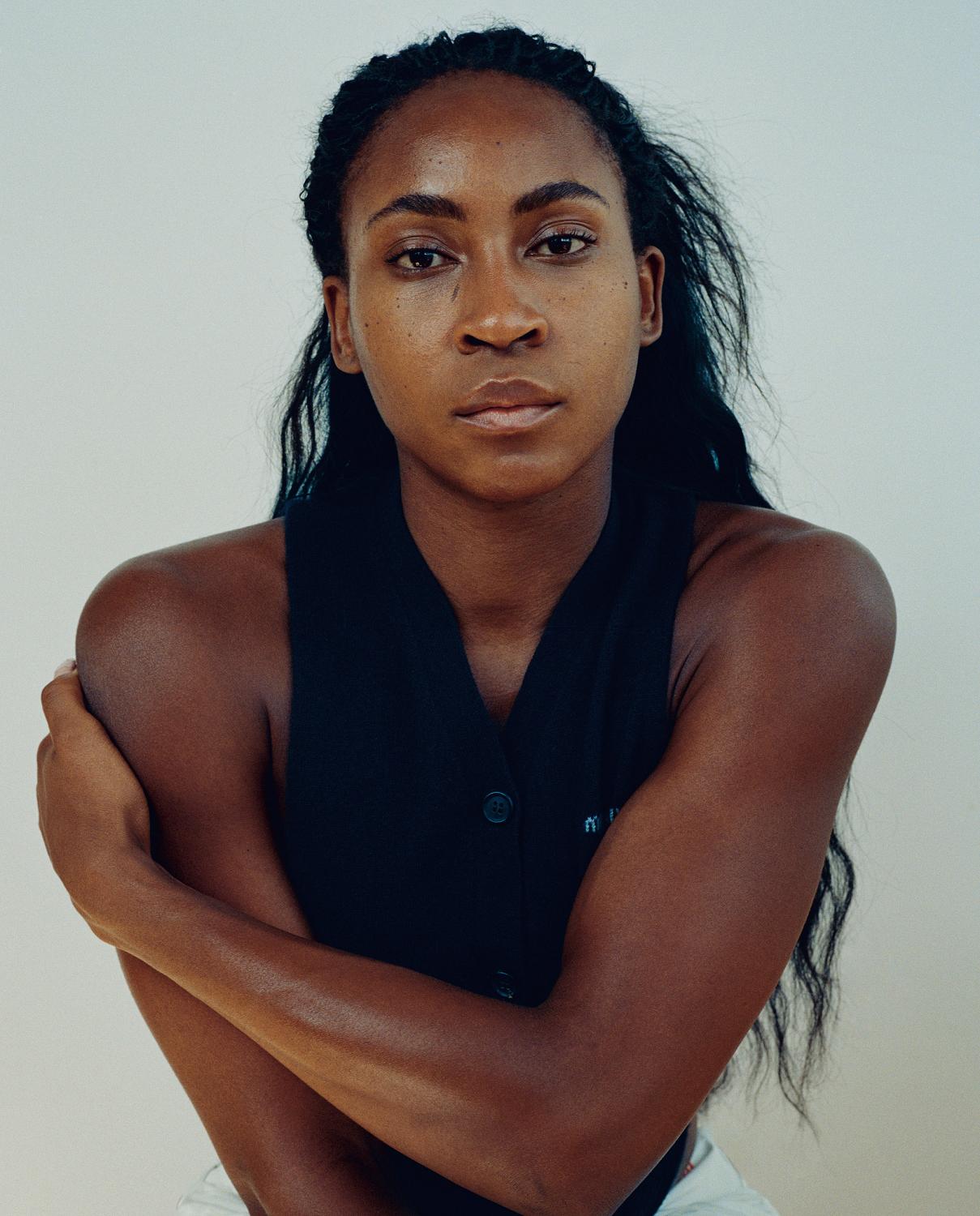
It’s Coco! Here and below, Coco is wearing a navy polo vest by Miu Miu. The white technical poplin trousers are from Coco’s latest capsule collection by New Balance x Miu Miu. Game, set, match!
After the Championships, Coco headed home to Delray Beach, Florida. Some players use that time to take a holiday, but not Coco. “Honestly, I’ve never been on a real vacation,” she says. “This year is gonna be the first year I will actually do that. I’m gonna go to an island somewhere, and I don’t want to travel far. The off-season is the only real window. Some people do it post-Wimbledon, but once I’ve been in Europe for a while, I’m just ready to go home.”
Once she’s back, she loves to hit the beach, and there’s no better indicator of her down-to-earth personality than how she beaches. No fancy cool boxes, tents or grills. “People who live near the beach, we literally just have a towel and a Pub sub.” A what? “Oh, you don’t know? Oh my God, it’s a sandwich from Publix, a grocery store in Georgia and Florida. They have really good sandwiches. We get a sandwich from Publix and maybe a gallon of lemonade and some barbecue chips and we’re out there. If you’re just there for like a couple of hours, that’s what we got.”
Her Pub sub order? “White bread, turkey, mayo, provolone, lettuce, pickles, salt and vinegar.”
Coco lives close to, but not slap bang on, the beach. “That’s somewhere I want to be one day, but the houses there are huge, and I’m just one person,” she says. As the highest-paid female athlete, with $33 million in earnings last year from prize money and sponsorship deals, she could probably buy up half the beachfront if she wanted. “Boca Raton is very high-society-type-thing, but where I live, in Delray, it isn’t really so much. Even if you’re wearing crazy stuff, somebody will look at you like ‘Why you gotta break it out right now?’”
One of the reasons Coco is trying to develop a more aggressive game and learn new shots and tactics is that the field is becoming stronger. In the 2025 season, the tour saw 35 different singles champions crowned across 53 tournaments. While top stars still claimed the major prizes, nearly 70 per cent of the calendar’s events were won by players outside the top ten rankings.
“Sports science has gotten better, and more people are doing the right thing,” Coco says. “When I started, the top 10 or 20 were focusing on the right things, but now I feel like the whole tour is working with a physio full-time, fitness coach full-time, coach full-time – things that probably people weren’t doing as much, like, 10, 15 years ago. It’s more competitive.”
Tennis players rarely tour solo. They have vast squads of experts who optimise their every move, using data for performance analytics, rally length strategies and player patterns. “I don’t really look at all that stuff,” Coco says. “My team does, and they filter down what I need to know. Because it is a lot. Even the stats between your body and your sleep. The thing might say you didn’t really get that much rest, but in your head you feel rested. Now you’re going to play and you’re like, Do I feel tired? I prefer not to know. I don’t want to be too reliant on the stats. But it is good to know where your body’s trending.”
Coco’s team has been remarkably steady. Her main coach, Jean-Christophe “JC” Faurel, has been with her since 2019 and her match against Venus at Wimbledon. Her physio, Maria Vago, has been with her “since forever”. She has the aforementioned MacMillan and her unofficial fitness coach, Fabien Cosmao. “I don’t know how to say his last name. It’s French. I always make fun of his last name, but I don’t know how to say it, so I’m not gonna try.”
But it is her parents, Candi and Corey Gauff (her brothers are Cameron, 13, and Codey, 18, giving the Gauffs some serious Kardashian-esque appellation appeal), who are her biggest support. One of them always travels with her. Corey and Candi were both athletes: Candi a gymnast turned track and field star at Florida State, Corey a basketball player at Georgia State. So when their daughter showed talent in tennis and wanted to head to the Mouratoglou Tennis Academy just outside Antibes to train with Serena Williams’s long-time coach, Patrick Mouratoglou, they made sure she got there.
“As a former gymnast, in order for me to get better I had to train in another state,” Candi tells me by email. “My parents would not allow me to live with a host family and train out of state. This was a turning point for me staying in gymnastics. I later became a track athlete.” When Coco wanted to go to the Mouratoglou Tennis Academy, her parents didn’t hesitate to back her. Coco trained in France and Florida throughout her childhood, turning pro when she was 14.
At any tournament, one of her parents will always be in her box, urging her on: Candi, looking hyper-focused, with a great game face and often wearing glossy black shades, or Corey, passionately animated and visibly stressed, sometimes mildly cursing from the sidelines (in a viral moment in Auckland in 2020, a 15-year-old Coco can be heard telling him off for saying damn). During Coco’s quarter-final Wimbledon match against her fellow American Jessica Pegula (her frequent doubles partner), Candi could be seen shouting “You gotta fight!” Meanwhile, Corey was in the States, driving Coco’s brother Codey to university in Missouri, where he was taking up a baseball scholarship. Seeing how they operate, it is easy to understand where Coco gets her clarity, confidence and competitiveness.
“Both my parents are pretty confident people, especially my dad,” Coco says. “His head is like [mimes ‘big’]. If I had a daughter like me – I’m just kidding – I’d have a big head too. No, but they both instil confidence in us. Whenever I had a dream, it was never just like, ‘Let’s think about it,’ or ‘Let’s see.’ It was always, ‘OK, what do you need? We’re gonna help you, support you.’ Not ever being told that you’re not good enough to do something built my confidence over the years.”
“Clay and grass are the biggest contrast. You’re basically playing opposite tennis.”
At the Miu Miu event the day after we meet, Coco is dressed in a matte black blazer and a minidress with brown faux-fur trim, hair piled up, face beat. This is the fourth Miu Miu x New Balance collection, and Miu Miu is the first fashion brand Coco has worked with – “and hopefully the only one,” she tells me that day. The on-court look is a minimal halter-neck crop top with a pleated skirt. “Whenever I have a nice outfit for a tournament,” she says, “it makes me wanna do better.”
Coco is on the road for at least 11 months of the year. In London, she likes to take the tube (she’s less fond of the New York subway). She goes on TikTok to track down matcha hotspots wherever she travels, though she didn’t find one in London. She does fan edits of her favourite anime shows, such as My Hero Academia. And she loves to chat to fellow Americans on the road. “I was in a nail salon in Madrid when I was talking to these exchange student girls,” she says. “They were super nice. Things like that just make me feel normal again.”
Coco loves a bargain. “Yeah. I love a deal and a dupe for sure.” She tells me that she can be a little “splurgy” with her online purchases. “I’m trying to be more intentional,” especially as the boxes get sent to her parents’ house, which drives her mother mad. “Sometimes she’s like, ‘What even is this?’ Sometimes I have to pretend that I remember when I bought it, because I can go on TikTok shop and just buy, buy, buy. She’ll send a picture and I’m like, ‘Oh gosh, I don’t remember buying that.’ But I act like I do, so she doesn’t get mad at me.”
This summer she has been obsessed with the American Love Island. “It has taken over my life recently. I started watching from season six. Then last year, oh my gosh – first thing in the morning, I was like, Love Island!” When we meet she is already a fan of Trinity, the eventual winner. It feels only right that Coco would back the winner.
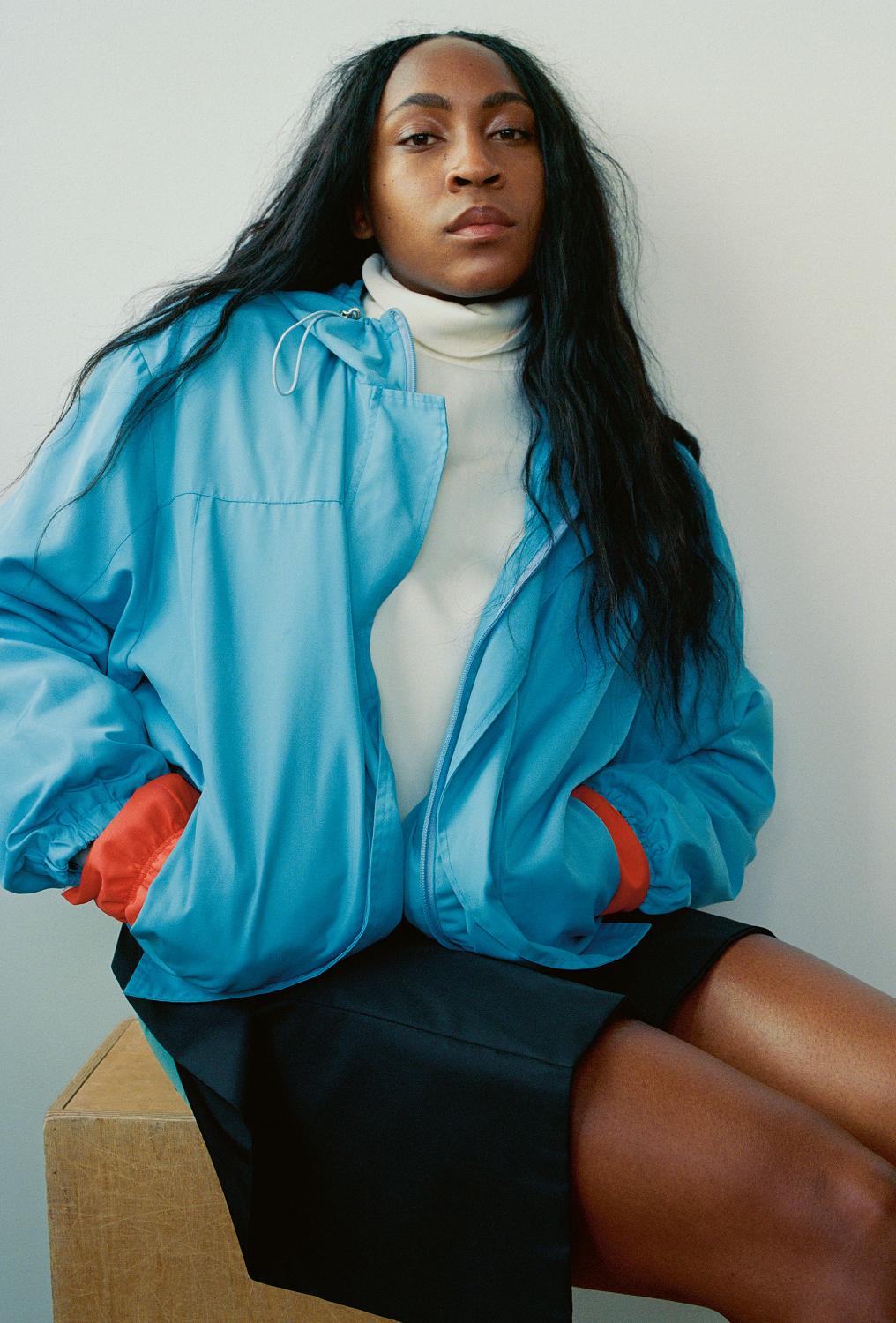
To date, Coco has won 11 singles titles and 10 doubles. She has a career-high ranking of world number one in doubles after winning the Canadian Open in 2022 with her partner Jessica Pegula. Here, she sports a blue poly-canvas jacket, a white cotton-blend top, a black poly-canvas skirt and orange poly-canvas gloves, all by LII.
Before she goes on court, Coco listens to Bad Bunny, Frank Ocean, J Cole, Ravyn Lenae and Faye Webster. “It’s just whatever I wanna put on that day.” She’s also a huge fan of Tyler, the Creator and is definitely the only tennis star to have loosely quoted one of his tracks in a victory speech. After beating Sabalenka to take the 2025 French Open crown, Coco – slightly sanitising the lyrics from “St Chroma” – said: “If I ever told you I had a doubt inside me, I must be lying. So I’d like to leave that with you guys. I think I was lying to myself, and I definitely could do it. So, shoutout to Tyler and shoutout to you guys. Thank you, Paris.”
At Tyler’s Camp Flog Gnaw festival in LA last year, Coco met the musicians Dev Hynes (who was performing) and Faye Webster, as well as Kyle Ng, who co-founded LA streetwear brand Brain Dead. All three are obsessive tennis fans. “Dev and Faye and I got all nervous walking up to Coco in the audience,” Ng tells me. “It was such a cute thing, because we all look up to Coco so much. We felt like little kids. Tyler mentioned her name in a song. I thought that was really funny. I don’t think she thinks about those things. She’s super cool and relaxed.”
After they got chatting with Coco, they asked her to play tennis with them. Surprisingly, she took them up on the offer despite not normally playing with amateurs – rarely much fun for her. “We took her to Silvertop, that Lautner house, and played out there,” Ng says. “It was a dream. One of the most iconic moments of my life. From then on we’ve kept in touch, and when I go around the world I’ll hit her up. I’ll be like, ‘Please, let’s play tennis!’”
It is unusual for tennis players to be tapped into less mainstream culture (we’re more accustomed to seeing Roger Federer at a Coldplay concert or Jannik Sinner appearing on a song with Andrea Bocelli). “Very few of them have the time to think about lifestyle and culture,” Ng says. “That’s why she’s one of the most influential young tennis players: because she can speak upon what it is to be a young woman in the world.”
Dev Hynes has been a fan since the early days of Cocomania. “She has such a well-adjusted head on her shoulders, and this ties into her taste outside of tennis. The fact that she is living a life that takes in different cultures, different activities, music, the arts – I think this is what gives her this incredible strength to be able to stay in matches when things aren’t going her way. It’s a very dangerous ability in her sport that not many people have.”
Coco weighs the idea up. “I think it helps with life, and life helps my tennis. But honestly, I don’t know. It’s just all intertwined.”
“I’d rather have an extra Slam under my belt than ever reach number one.”
Ever since her career took off, Coco has used her platform to talk about issues that matter to her. She uses the brands she works with to achieve more, too. “I’m lucky; they’re always trying to find a way to tie it back to my roots and my community, because they know it’s important to me.” She runs a community project with New Balance that highlights grassroots tennis and refurbishes local courts in places including Delray Beach’s Pompey Park, where Coco played as a child. “When I launched the Delray shoe, New Balance put on a whole event for my community, with free food and shoes and a field day, because I always liked doing that as a kid in the park,” Coco says. “It’s a historically Black community. It’s not a club, just a public park where anyone can play. Tennis is expensive. Kids need hours on the court. It’s always been free, but the courts were run-down, and you don’t want to play on a bad court. It was really cool. It’s cool to be able to give back where you can.”
The event took place on 18 March 2025, just days after her 21st birthday and was a deeply personal tribute to her hometown, her heritage and her grandmother Yvonne Lee Odom, who famously desegregated Palm Beach County public schools in 1961 as the first Black student at Seacrest High School. Her grandmother narrated an accompanying short film that showed footage of Coco’s upbringing and the community around the public tennis courts in her old neighbourhood.
Coco wants to make sure Black tennis history doesn’t get forgotten and is always conscious to namecheck Black tennis pioneers beyond the Williams sisters – Arthur Ashe, Althea Gibson, Zina Garrison, MaliVai Washington, Chanda Rubin, Sloane Stephens, Frances Tiafoe.
“I was talking to someone the other day, and they didn’t know who Althea Gibson was. That was crazy for me.” In 1956, Gibson became the first Black player to win a Grand Slam title when she defeated the world number one, Angela Mortimer, at the French Open. Gibson went on to win 11 Grand Slam tournaments across singles and doubles. The person Coco was talking to “was someone who’s in the sport,” she says. “I was just like, ‘Oh, wow.’ So it’s something I continue to speak about, because we hear about Chris Evert and Steffi Graf, and although they had statistically better careers, it’s important to mention people like Althea and Zina Garrison. They may have not won as many Slams, but the impact that they’ve had on the community of players is very important.”
In May, on the eve of this year’s French Open, Coco was dragged into a social media storm for attending the “Black party”, a dinner Naomi Osaka co-hosted with the number one doubles player Taylor Townsend in Soho House Paris. The guests included Gael Monfils, Asia Muhammad and Chris Eubanks. The intention was to celebrate Black players in tennis, a sport where representation has historically been sparse.
“I guess if you’re not really from a minority community then it’s hard to understand,” Coco says. “These spaces have existed for many years, and people have to remember the history of the world, especially the US. Separation wasn’t our choice. It was something that we were forced into. Of course we’re gonna create our own spaces to do that. And with tennis being a predominantly white sport, you don’t really see people who look like us too often. I remember growing up and playing some tournaments and I was the only Black person within a 50-to-100-mile radius. People don’t realise why it’s important to have these spaces where you can feel a sense of normalcy with people, knowing they have the same shared experience. And to be able to have those conversations and learn from each other about how to cope with it.”
She is excited that the tennis tour is diversifying in new ways. Players from non-traditional tennis countries are bringing big crowds with them: João Fonseca (Brazil), Zeynep Sönmez (Turkey), Ignacio Buse (Peru), Hady Habib (Lebanon), Mayar Sherif (Egypt), Alex Eala (the Philippines). “The more people who get involved the better. It just takes one standout player who inspires a generation to play,” Coco says. “I enjoyed the environment when I played Alex in Dubai. It was, like, a 100 per cent Filipino crowd, and even if they’re not cheering for you, it’s just the excitement they have. It’s an emotional thing, because the sport has existed for so many years and this is the first time they’re seeing someone who looks like them on the stage.”
You can sense that every year Coco feels more comfortable. At just 22, she’s practically a veteran. “When I first came on tour I was years younger than everyone, so at the beginning it was hard. Now my generation is starting to come on tour and meet me, so it’s been a lot easier the last few years. When I was 15 everybody else was 25 to 30; half the people you’ve watched on TV for years, so you’re too scared to talk to them. And the other half are way older or don’t even speak the same language. So it was definitely different.”
As she matures out of being the wunderkind, does she find it strange facing teenagers herself? “No, I got kind of tired of being the one. I was kind of just ready for it not to be me any more. So it doesn’t really feel weird,” she says. “It’s just the circle of life.”
Stuart BrumfittStuart has covered fashion, music, film, TV, art, design, sports, travel and LGBTQ+ life for the likes of Fantastic Man, GQ Style, The Face, i-D, Vice, Dazed & Confused and Attitude. He is also the founder and editor of BAGEL, a splendid tennis lifestyle magazine. Who better, then, to meet Coco Gauff…read more Portraits by
Deo Suveera & Pamela DimitrovDeo Suveera & Pamela Dimitrov are among fashion’s most exacting observers, known for their textural photographs that bear witness to the sublime details of everyday life. Based between Bangkok and London, the husband-and-wife duo have shot for Jil Sander, Hermès and Bottega Veneta. Editorially, their…read more
Styling: Helena Hiegemann. Hair: Pawel Solis at Artlist Paris. Make-up: Manu Kopp at Artlist Paris. Manicure: Melvyn Renaud at Artlist Paris. Photographic assistance: Josephine Berneau, Louis Lac. Styling assistance: Federico Pozzi, Ginevra Pesenti, Breno Vasquez. Production: Tarifa Productions.