Autumn Durald Arkapaw
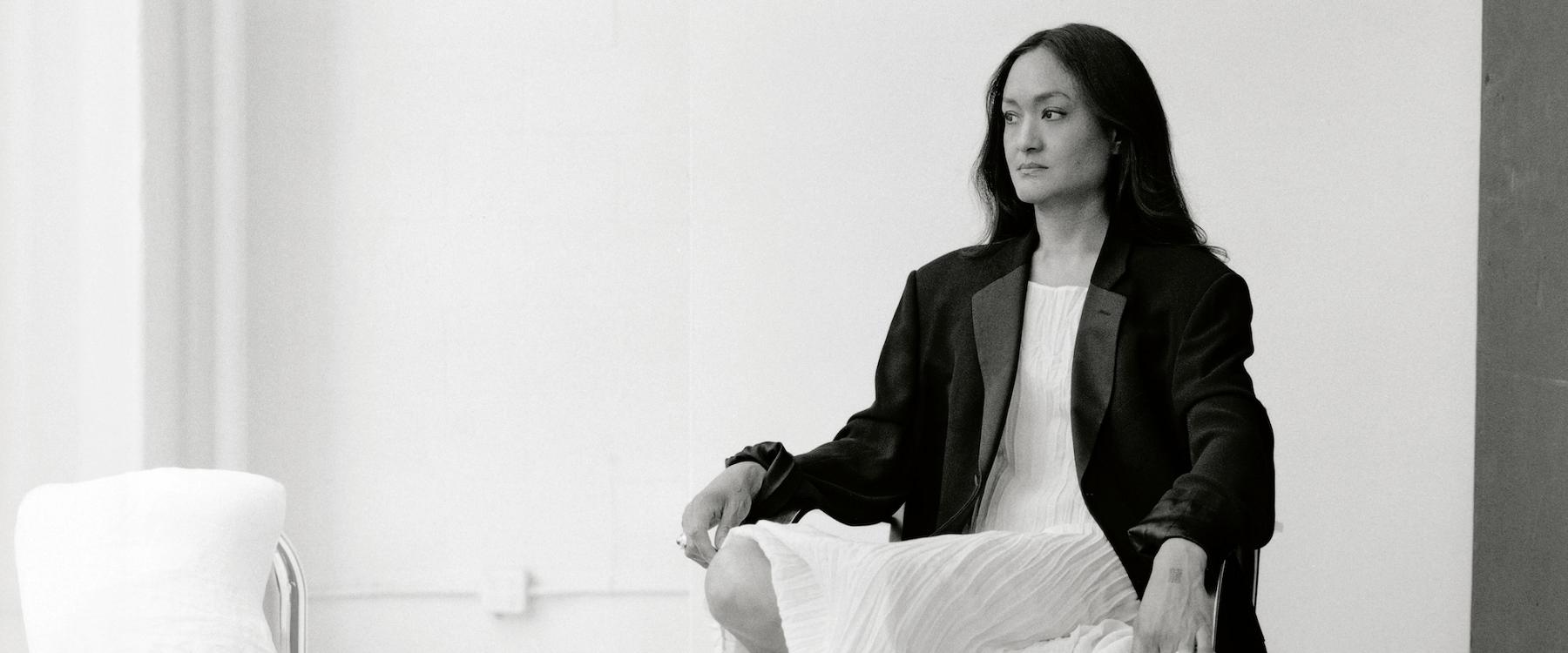
Autumn Durald Arkapaw was destined to be in the movies. Her parents named her after Cheyenne Autumn, John Ford's 1964 epic Western. It was at university and through watching films such as Trainspotting and Heat that Autumn found her calling as a cinematographer. Forty-two projects later, in March this year, Autumn, 46, became the first woman to win the Academy Award for best cinematography, for her work on Ryan Coogler's Sinners. She shot it on a 30-kilogram IMAX camera, which she nicknamed her “little refrigerator”, and a rare Ultra Panavision 70, both hauled through the sweltering heat of Louisiana to sun-drenched, shadow-thick effect. She and her cinematographer husband are bringing up their 10-year-old in Los Angeles, not far from where she's shooting Marvel's and Coogler's next Black Panther instalment. Autumn, evidently, is just beginning.
Seated in the Dolby Theatre for the Academy Awards in March, Autumn Durald Arkapaw was scanning everything in her glimmering orbit for signs. Would she be taking home the statue for best cinematography for Sinners, or would it slip away? On the one hand, her assigned aisle seat boded well; on the other, the primary predictor of Oscar success, the American Society of Cinematographers award, had gone to Michael Bauman the week before for One Battle After Another. As the evening progressed and few of the 16 record-breaking nominations for Sinners panned out, she resigned herself to simply enjoying the show.
Then she discreetly texted her publicist to ask who would be presenting the award. The answer: Demi Moore. “All of a sudden, I became really, really positive,” Autumn tells me months later when we meet at an outdoor cafe in Eagle Rock, a north-east Los Angeles neighbourhood not far from the home she shares with her husband, Adam Arkapaw, also a cinematographer, and their 10-year-old son, Aedan.
This is the first time she has told the Oscar story, and the electricity of the moment burns brightly. “If this actually happens, I’m going to thank every woman in the room,” Autumn remembers telling herself. The thought “just popped in my mind.” After Moore said her name and Ryan Coogler, the director of Sinners, rocketed out of his seat, Autumn took to the stage in her custom-made Thom Browne ensemble: silk skirt, organza shirt, black tie and lace-embroidered overcoat.
At first, she says, she stuck to her speech, naming the women who directly inspired her: Ellen Kuras, the first female cinematographer Autumn knew of as a college student, and Rachel Morrison, her friend and the first woman to be nominated for best cinematography, for Mudbound in 2018. Then, in a moment that would go viral, Autumn, in her soft, commanding voice, asked all the women in the room to stand up. “I feel like I don’t get here without you guys,” she said, a slight quiver hinting at the emotion. As performers, directors, make-up artists and others rose to their feet, the rest of the audience cheered raucously. Morrison, who was watching with friends in Mexico, tells me she “was moved to tears, because it represented so much more than her singular journey. It’s been nearly a century, and she finally broke through the glass ceiling.”
Autumn was the first woman (and the first person of colour) to win for best cinematography; after Morrison, Ari Wegner was nominated in 2021 for The Power of the Dog, and Mandy Walker in 2022 for Elvis. She is also the first female cinematographer to shoot on IMAX 65-millimetre and Ultra Panavision 70, two grand-scale film formats. (Shooting in the steamy heat of Louisiana, she carried the 30-kilogram IMAX camera on her shoulder, affectionately referring to it as her “little refrigerator”.)
At a time when AI threatens to destroy the humanity of the creative process, Autumn wants “to make sure every single moment is good, that it’s all emotionally and cinematically felt. I love movies that give you scope,” she says. “I want it to feel like a movie, and like you’re watching a movie because it’s giving you a view that’s wider than what you normally see. It feels like you’re right in the landscape.” The decision to shoot Sinners, set in the Jim Crow era of harsh racial segregation, on large format was important. “Ryan would always say, ‘We haven’t seen these characters with these faces on formats like this ever.’ It really elevates those people and their culture.”
Autumn is still benefiting from the Oscar bump with more work, and unimagined opportunities such as throwing out the first pitch for the LA Dodgers on their Black Heritage Night. But most important for Autumn is that “it just gave hope to so many women,” she says, telling me about a flight attendant of Asian descent who congratulated her at the airport recently. Her victory has shown people “that we can make a change. Women can be strong, and we can do things in this industry and beyond.”
Women have yanked open plenty of doors in Hollywood, but the one to cinematography has been jammed shut more tightly than most. The heavy equipment alone, the old saw went, would make success near-impossible for them. Autumn labels that “a farce”, with amusement rather than anger. “They were saying it just to keep us out. After being pregnant, going through childbirth, raising a child – there’s no bigger strength than that. Like, a 35-pound camera?” she says. “Or heavier, like I operated? You find the strength within you to make it happen.”
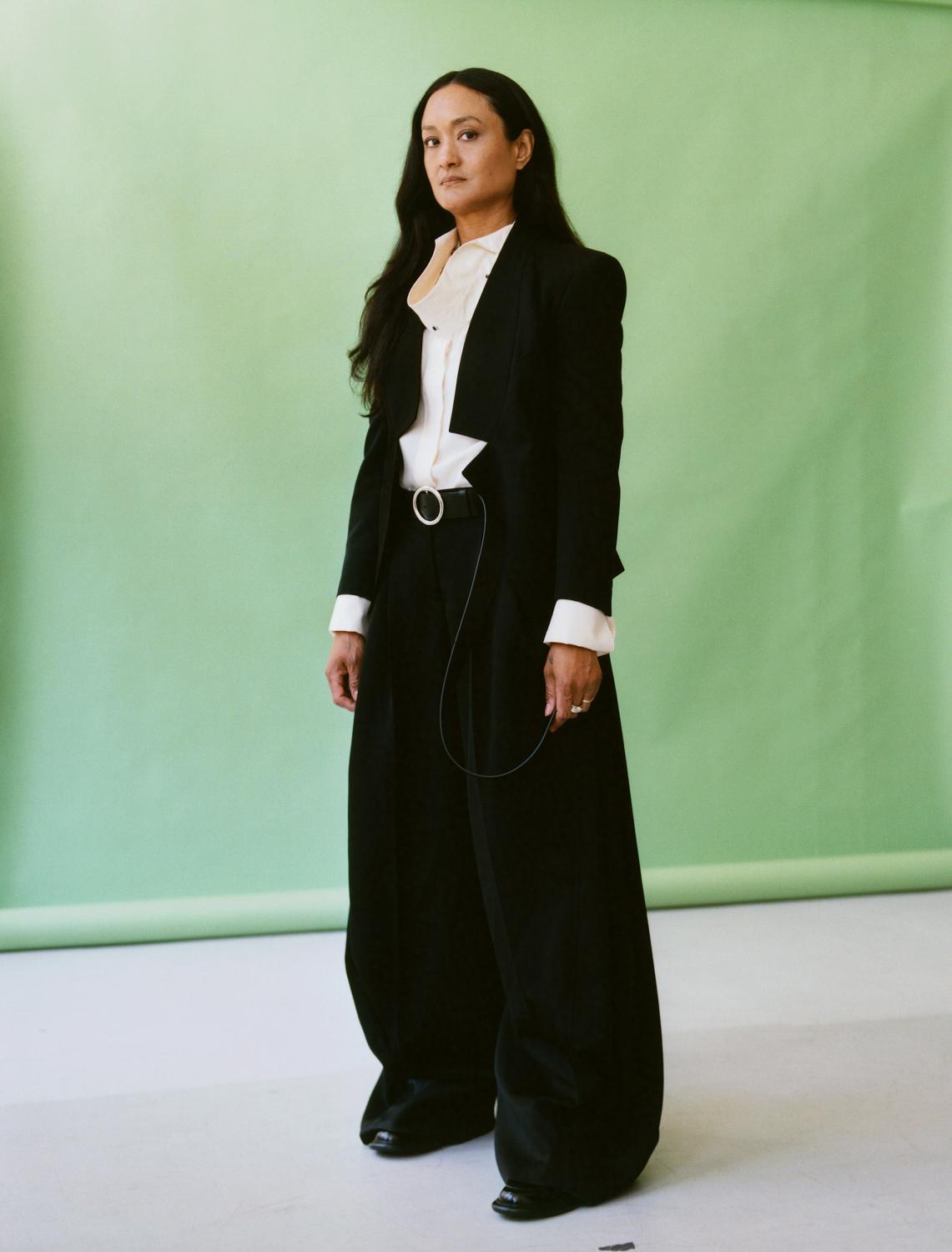
Here, Autumn is wearing a black wool jacket, black wool trousers, a white silk shirt, black leather loafers and a black leather belt, all by Givenchy by Sarah Burton. The sterling-silver-and-white-sapphire ring on Autumn's middle finger is by Chan Luu; the other ring is her own.
Autumn seemed predestined for cinema – the romantic adventure of it and the myriad challenges. Her parents named her after their favourite western, John Ford’s 1964 epic Cheyenne Autumn, shot in (wait for it) 65-millimetre. She was born in Oxnard, LA, but after her parents separated when she was two, she and her Filipina mother moved north to San Leandro, in the San Francisco Bay Area. “I had my family so close. My mom has six brothers, so I had a lot of cousins.” Hours were spent at the local cinema or gazing at her grandparents’ photos of their travels in America and England.
Then, when she was eight, Autumn and her mother moved to suburban Danville so Autumn could attend a better school. At the time the area wasn’t very diverse. “I never felt like an outsider,” Autumn says, “because my mom worked so hard. She’s an entrepreneur and has worked in global trade for 35 years. It was true that we had less than other people. We were in smaller homes, but my mom always made them beautiful.”
By the age of 20 she was cutting iMovies of her friends hanging out and soundtracking them herself, hinting at her future making music videos for Rihanna, Solange, Haim and others. “But my whole thing was being a photographer,” she says. “I never put my finger on it that I wanted to be a filmmaker.” Instead, she followed her interests in photography and fashion and studied art history at Loyola Marymount University.
At university she took a mandatory film genres course, and in the black-and-white glow of Raging Bull and Broadway Danny Rose, “I wanted to know everything. Who’s shooting it? Who’s making these things? What is that job like?” Those questions eventually led her to look into cinematography, and specifically to look for a woman cinematographer. It was only when she checked the credits on Blow, one of her favourite films as a teenager, and saw that Ellen Kuras was the director of photography that she thought, “Oh, there’s a girl. Great, I can do it! In my mind, if you’re raised by a single mom and you’re looking up to her, watching her do stuff, that’s it. There’s one, and so there can be two.”
The reality proved less straightforward. After graduating in 2002, Autumn spent three years at AOL, in a “nice job”. Her boss paid for a one-night-a-week UCLA extension course in cinematography. In 2005, Autumn applied to the prestigious American Film Institute (AFI) Conservatory and didn’t get a place. But she made the alternate list, and the head of cinematography encouraged her to get more experience and reapply. “I got a wonderful job as a first assistant camera on the documentary series On the Road in America and travelled across the US and eventually to the Middle East.” Autumn did reapply to the AFI cinematography course and was accepted.
Her fellow students would become her constant collaborators, her on-the-run teachers. Between her first and second years, she shot the mumblecore drama Macho for her classmate Rafael Palacio Illingworth. The 35-millimetre film won the award for best micro-budget feature at the indie Raindance festival in London in 2009. After graduation came another low-budget indie, Guadalupe the Virgin, directed by Victoria Giordana.
Then, in 2011, another AFI student introduced her to Gia Coppola. Coppola was looking for a fill-in DP for a test shoot for her first feature, Palo Alto, based on James Franco’s short stories. That day yielded one of Autumn’s most fruitful relationships. “I love working with her,” Autumn says. “We have that trust because we’ve worked together our whole careers.” After doing fashion shorts together, she and Coppola built the visual language for Palo Alto. “She’ll send me these references, and I’ll know exactly what she’s after.” Think landmark teen movies like The Last Picture Show, Dazed and Confused and, from the Coppola family canon, The Outsiders and The Virgin Suicides; Instagram images of messy teenage bedrooms; and the photography of William Eggleston and Stephen Shore. Coppola and Autumn’s collaborations are all stylised play.
“I love movies that give you scope, like you're right in the landscape.”
It was AFI, where she now guest-lectures, that taught Autumn “how important it is who you’re working with, especially for someone like me who doesn’t come from a film family.” So when the time came to find the right look for Palo Alto, she contacted Panavision, which she’d worked with as a student. It was the beginning of a lasting association with the company. To help her achieve the nostalgic 35-millimetre look she wanted on digital video, Panavision provided Zeiss Super Speed lenses, which delivered a saturated, grainy softness. Palo Alto led the director Max Minghella to ask her to shoot a music video, and later his first feature, 2018’s Teen Spirit. Autumn also caught the attention of the legendary director Spike Jonze, who hired her as his cinematographer on the Netflix comedy special Aziz Ansari: Right Now (2019) and later for Apple TV+’s Beastie Boys Story (2020). Before long, Kate Herron, the director of the first season of the Marvel Cinematic Universe’s TV series Loki, had drafted her in. Autumn received her first Primetime Emmy Award nomination for her work on episode 3, “Lamentis”.
In January 2024, she was reunited with Gia Coppola for The Last Showgirl, starring Pamela Anderson as a performer whose Vegas revue is ending after 30 years. They were shooting on 16-millimetre, and Autumn asked Panavision to create a lens especially for her. “I wanted to make an anamorphic lens that I could shoot Super 16-millimetre with and get a 2.39:1 aspect ratio,” she says. “There’s a lot of softness on the edge of the frame, but you have the women clear in the centre. It’s just a beautiful format.” Panavision’s bespoke lens captured a fishbowl feeling reflective of the story’s undertones of desperation and faded glamour. In the back of her mind, Autumn tells me, she was thinking she would use this lens for Ryan Coogler’s next project, code-named Grilled Cheese, on which they were going to collaborate. “Ryan envisioned it in 16-millimetre, something with this grittier feel. But then Sinners changed completely,” she says.
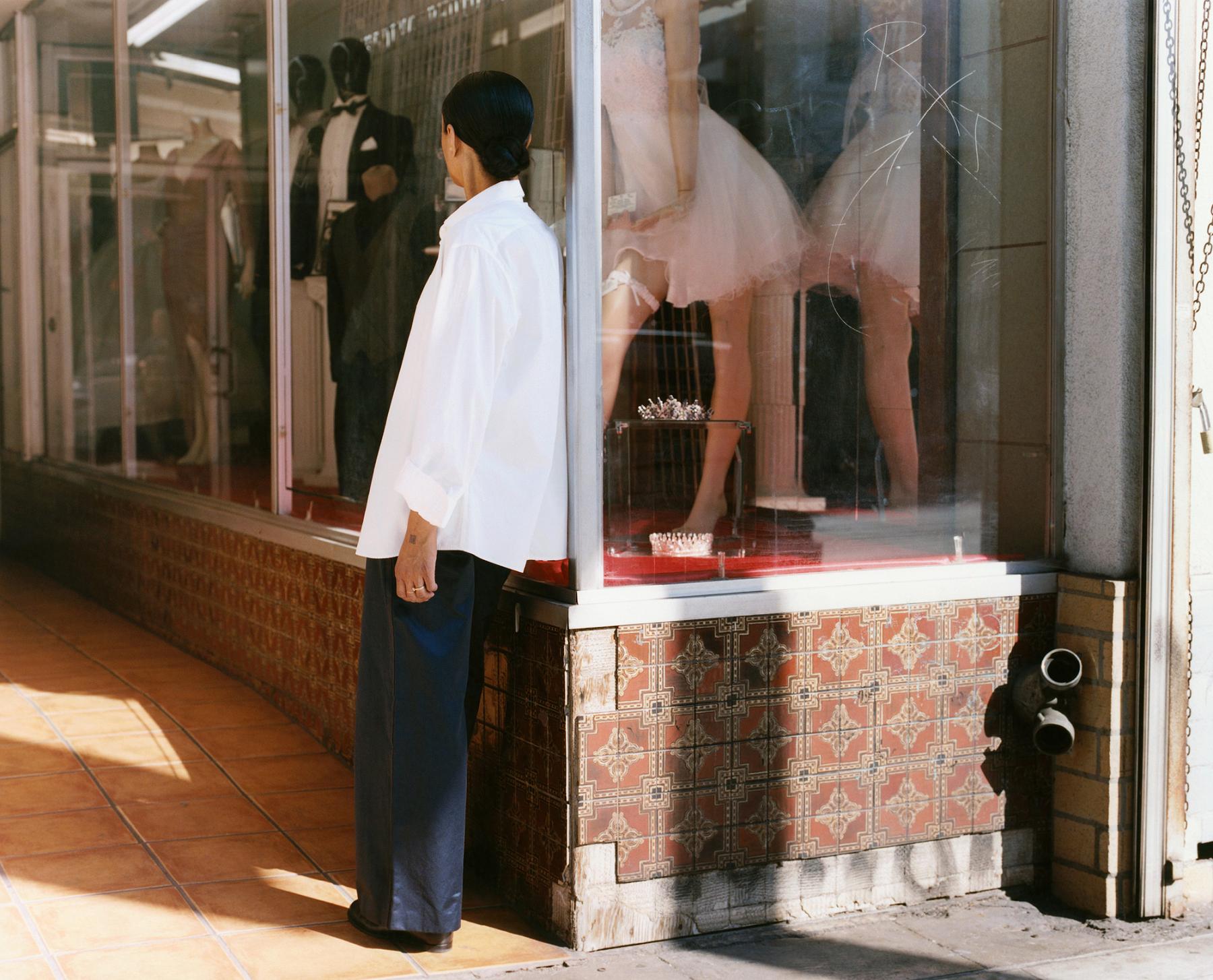
Photographed in Downtown Los Angeles, three miles from Dodger Stadium, Autumn wears a Dries Van Noten shirt and Gucci trousers, both vintage, both from Paumé. The black leather brogues are her own.
Autumn and Coogler met when Rachel Morrison, his cinematographer for Black Panther, was unavailable for the follow-up, Wakanda Forever. Morrison had a hunch that the two would hit it off. “Ryan surrounds himself with others who share a sense of empathy and intrigue,” she tells me by email. “He’s also incredibly thorough and believes in pushing the boundaries. Autumn invests and pushes herself.” Autumn tells me that at work she is “very dialled in, very serious. But I also laugh a lot because I’m working with friends.”
Morrison’s hunch was correct. Working with Coogler felt immediately familiar, Autumn says. Along with Gia Coppola, he’s become “like family” to her. “I want to work with people I believe in, that I enjoy being around and who I care about, and that’s Ryan.” After Wakanda Forever’s complicated year-long shoot, their working relationship became so strong that Coogler described it to The New York Times as “like gravity”.
For Sinners, the challenge was in shooting Michael B Jordan playing identical twins, the hustler brothers Smoke and Stack. Coogler and Autumn found inspiration in Eudora Welty’s photographs of daily life in Depression-era Mississippi and the Farm Security Administration’s Kodachrome slides held in the Library of Congress – along with Quentin Tarantino’s The Hateful Eight. “I wanted to show the land,” Autumn says. “I wanted to show the distance and that flat horizon.” After some test shoots in the California desert there was no going back: they embraced the texture and richness of extra-large film stock.
Though she has shot digitally to acclaim, namely for Palo Alto, Autumn prefers anamorphic lenses, which squeeze the image horizontally, allowing for a wider field of view, better vertical resolution and less grain. She likens the effect to looking through old glass, which “has texture and nostalgia. It’s worked in, like an old photograph. I want something to feel like it’s from the past, to get you emotional, because that’s what it’s all about.”
The anamorphic lens is part of US cinematic history. In the early 1950s, by which time more than half of US families owned TVs, Paramount and 20th Century Fox developed a widescreen filmmaking process called CinemaScope to lure viewers back to the movies. Anamorphic took over and continued to reign in the kinds of 1970s and 1980s auteur movies that inspired Autumn in her early days at university: Chinatown, Apocalypse Now, The Empire Strikes Back. In a sense, Sinners took her back to the beginning. The film reverberated into her family life as well: she reconnected with her father’s Louisiana family on the shoot. One of her paternal aunts, Janis, can be seen in the grocery store scene.
Autumn has just wrapped the pilot for Coogler’s X-Files reboot in Vancouver when we meet, and they’ll be collaborating again on the next Panther instalment, scheduled to shoot in 2027. Asked about it, she says only that “people should be excited. He’s such an exciting filmmaker that when he’s excited his team gets excited.”
Filming is a physically demanding job, and Autumn conditions her body by doing Pilates and playing tennis. “My coach is the loveliest, and I always enjoy learning the game,” she says. At home in Los Angeles, where she has lived since moving there for university in 2000, she and Aedan watch the Netflix show Formula 1: Drive to Survive. They used to see films at the Cinerama Dome on Sunset Boulevard (“I’m a sucker for popcorn and Raisinets”), fittingly, as it was designed to show extra-widescreen Cinerama films, until it closed in 2020. “But they recently announced that the Alamo Drafthouse Cinema will replace it,” she says.
Autumn’s success is an American story. The Oscar for Sinners didn’t come her way simply because it was high time to recognise a woman. Her work shines with a confidence that says: We belong here. There’s the all-too-singular joy of being on a set brimming with people of colour. But the message of belonging is most clarified in how she lights non-white skin.
“I won’t name names,” she says, “but when something’s being overlit, you can tell that that photographer is afraid a little bit, so they want to ‘make sure’. I feel like what’s cool about working with Ryan is that we’re very brave. We want to do what’s right emotionally for the character and for the story. It’s not about being afraid that someone is coming in and out of darkness, or being afraid of someone who has a very dark skin tone. There’s beauty in that, and there’s a way to light that. It’s just a trust.” Blowing out skin tones and facial expressions with too much light also screams that the camera is right there, breaking the spell.By letting faces fall into shadow, eyes eclipsed by darkness, Autumn is foregrounding a different truth. “It’s about beauty, really,” she says, as the late afternoon sun burnishes us gold. “This is why finding the right people to work with is so important. Culturally, you’re on the same page. You ask them, ‘What do you find beautiful?’ Some people will criticise letting an actor’s face go dark, but I’m OK with it and Ryan is OK with it. This is what’s going to be most beautiful, because it’s real.”
Margaret WapplerMargaret Wappler is a writer based in Los Angeles. She has interviewed the likes of Serena Williams, Margaret Atwood and Amy Adams and has written about arts and culture for the New York Times, Rolling Stone, Los Angeles Times and Washington Post, amongst others. Margaret is also the author of Neon Green,…read more Portraits by
Angalis FieldAngalis Field is a photographer, screenwriter and director based in New York City. Known for his intimate portraiture, Angalis’s work has appeared in magazines such as i-D, The New York Times and HommeGirls. His short films, The Dalles, a queer coming of age neo-Western, and Bust, a political thriller…read more
Styling: Camilla Pole. Hair: Ramsell Martinez at Mode Agency. Make-up: Anna Kato. Photographic assistance: Steve Yang. Styling assistance: Chantz Norris. Production: Connect the Dots
This profile was originally published in The Gentlewoman nº 34, Autumn and Winter 2026.